Fertilizer burn on plants: how to flush out the salts
Fertilizer burn on plants happens when too much fertilizer leaves salts in the soil that pull water out of the roots. British gardeners call it fertiliser burn. Potted plants get it most, because the salts build up in the pot with nowhere to go.
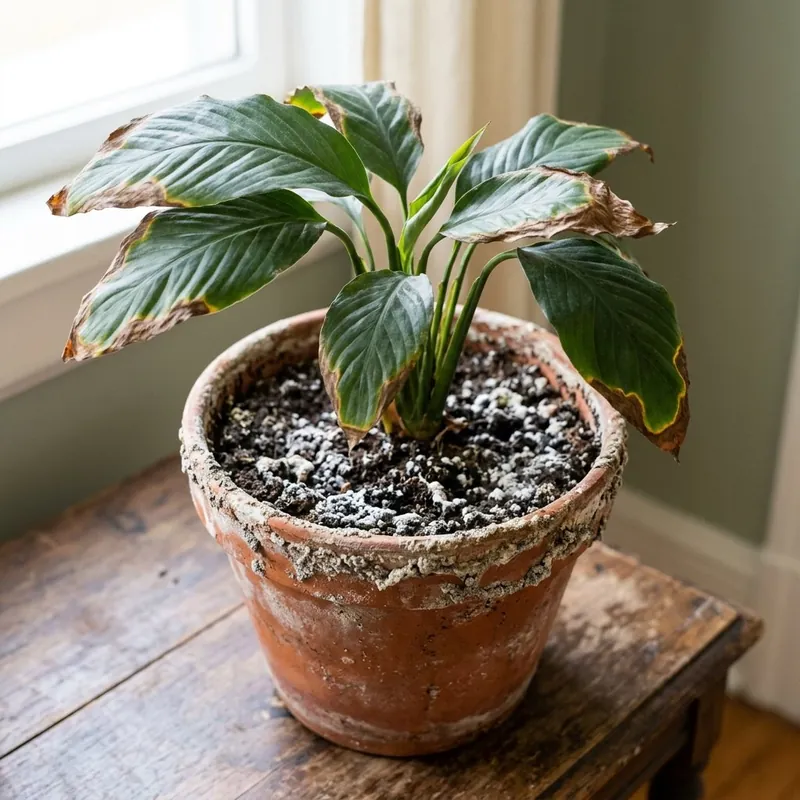
Short answer: Fertilizer burn shows as brown, crisp leaf tips and edges, wilting even though the soil is damp, and often a white or tan crust on the soil or pot rim. Flush the salts out by running plenty of water through the pot until it pours from the drainage holes, let it drain fully, then let the soil dry as usual. Stop feeding for a month, then restart at half strength.
What it looks like
- Brown, crisp leaf tips and edges
- Wilting even though the soil is still damp
- A white or tan crust on the soil, the pot rim or around the drainage holes
- Yellowing leaves, often the lower ones first
- Damage showing up soon after a feed, especially one given onto dry soil
- Brown, damaged roots and slow growth
Is it fertilizer burn or something else?
| Could also be | How to tell |
|---|---|
| Low humidity | Dry air also browns leaf tips, but there is no crust on the soil and the plant doesn't wilt in damp soil. |
| Underwatering | A thirsty plant wilts in dry soil and perks up within hours of a good drink. A burned plant wilts while the soil is still damp. |
| Root rot | Rotting roots also make a plant wilt in wet soil, but the roots are soft, mushy and smell bad, and there is usually no white crust or recent heavy feeding. |
Why it happens
Fertilizers are salts. A little dissolved in the soil feeds the plant, but too much draws water out of the roots and dries the tissue. The leaf tips and edges, farthest from the roots, brown first.
Salts build up in pots when you feed too often or too strongly, feed onto dry soil, or keep feeding a plant that is resting in winter. Hard tap water adds minerals of its own, and a pot standing in a saucer of drained water soaks the salts back up.
Stressed plants burn most easily. Roots that are dry, damaged or not growing can't cope with a feed that a healthy plant would use.
How to fix it
- Rinse out the salts. Take the plant to a sink or tub, or outdoors, and pour plenty of water slowly through the soil. Keep going until a lot has run out of the drainage holes. The University of Maryland Extension suggests at least three times the volume of the pot.
- Let it drain fully, then let the soil dry as usual. Don't leave the pot standing in the salty runoff. Once it stops dripping, put it back in its place and wait until the soil is dry before the next watering.
- Scrape off any white crust, or repot. Lift off the crust with a spoon, taking only the top layer of soil. If the plant is badly burned or the crust keeps coming back, repot into fresh potting mix. Scrub crusted pots before you use them again.
- Stop feeding for a month, then feed at half strength. Give the roots time to recover. When you start again, mix the fertilizer at half the strength on the label and water it into soil that is already slightly moist.
- Trim the brown tips if you like. Burned tips won't turn green again. Snip them off with clean scissors, following the leaf's shape and leaving a thin brown edge so you don't cut into healthy tissue.
Watch out: Feeding a struggling plant feels like helping, yet extra fertilizer on dry or stressed roots burns them. Feed only healthy plants that are actively growing, and never onto dry soil.
How to prevent it
- Feed only during the growing season, at the label strength or weaker
- Water first and feed onto slightly moist soil
- Use pots with drainage holes, and empty saucers after watering
- Flush potted plants with plenty of water a few times a year to wash out built-up salts
- Water with rainwater or other low-mineral water if your tap water is hard
Plants it often affects
- Orchid fine roots burn easily, so orchids need weak feeds
- Peace lily leaf tips turn brown and crisp after heavy feeding
- Spider plant brown tips are often the first sign of salt buildup
- African violet leaf edges brown and a crust forms on the pot rim
- Seedlings young roots burn quickly, so feed them only weakly
Questions people ask
Can a plant recover from fertilizer burn?
Usually, if you catch it early. Flush the soil, let it dry and hold off feeding for a while. Burned tips and edges stay brown, but new leaves should come in healthy.
What is the white crust on my plant's soil?
It is a buildup of salts from fertilizer and hard tap water, drawn to the surface as the soil dries. Scrape it off and flush the pot with plenty of water. A pot that stands in its own drainage water makes it worse.
How often should I fertilize houseplants?
Only while they are actively growing, in spring and summer, at the label strength or weaker. Most houseplants need nothing in winter. Extra fertilizer only adds salts that the roots have to cope with.

Not sure it's fertilizer burn?
Take a photo in Liana and the health check names the problem and tells you what to do first. Liana also reminds you to check the soil, so watering mistakes don't start. Get Liana for iPhone.
Sources
- University of Maryland Extension, Mineral and Fertilizer Salt Deposits on Indoor Plants
- Colorado State University Extension, PlantTalk Colorado, Whitish Crust on Potting Mixes