Brown leaf tips from tap water: fluoride and salt damage
Brown leaf tips from tap water are common on dracaenas, spider plants, calatheas and prayer plants. These plants react to fluoride, chlorine and salts in tap water, which build up in the pot over months of watering. The browned tissue won't recover, but switching water stops new damage.
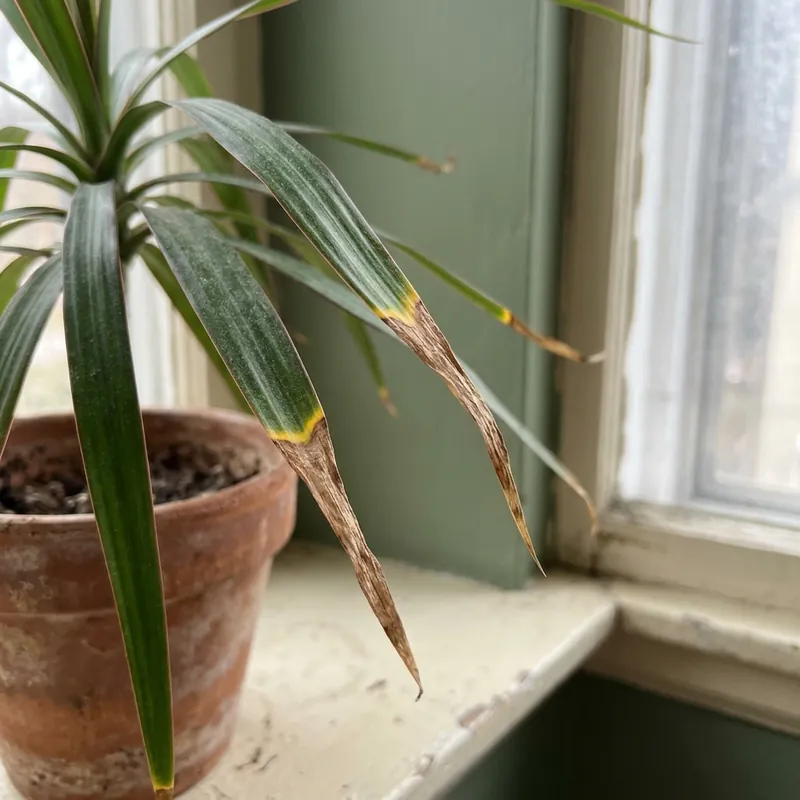
Short answer: If a dracaena, spider plant or calathea keeps getting brown tips and edges, often with a thin yellow band, even in a humid room, the tap water is a likely cause. Switch to rainwater or distilled water, flush the pot once with that water to wash out built-up salts, and trim the brown tips with clean scissors.
What it looks like
- Brown, dry leaf tips, often with a narrow yellow band between brown and green
- Browning that creeps along the leaf edges over time
- Damage worst on older leaves, where fluoride has had longest to build up
- Long, strap-shaped leaves affected most, such as dracaena and spider plant
- A white crust on the soil surface or the pot rim from salts
- Tips that keep browning even though humidity and watering are fine
Is it tap water damage or something else?
| Could also be | How to tell |
|---|---|
| Low humidity | Dry air also browns tips, mostly in winter when the heating is on. If tips keep browning in a humid room or a bathroom, the water is the more likely cause. |
| Fertilizer burn | Too much fertilizer gives the same brown tips and white crust, but it follows feeding and can make the plant wilt in damp soil. Tap water damage builds up slowly without heavy feeding. |
| Underwatering | A plant left too dry gets brown tips along with limp leaves and dry soil that pulls away from the pot. Letting the mix dry out too far also concentrates salts, so check your watering as well. |
Why it happens
Many public water supplies contain fluoride, either added or naturally present, and it builds up in leaf tips and edges, where water ends its journey through the leaf. The PNW Plant Disease Management Handbook names corn plant and other dracaenas as very sensitive. University of Missouri IPM adds that plants in the lily family are especially sensitive, and that perlite in potting mix also contains fluoride.
Salts from hard or softened water and from fertilizer collect in the potting mix too, especially when the pot never drains through. Chlorine adds to the stress for sensitive plants. Damage creeps up slowly, which is why a plant can look fine for months and then start browning.
How to fix it
- Switch to rainwater or distilled water from today. Collect rainwater in a clean container, or buy distilled water, and use it for sensitive plants. Let it reach room temperature before watering. Avoid water that has been through a water softener, which adds salt.
- Flush the pot once with rainwater. Take the plant to a sink and pour rainwater or distilled water slowly through the mix until it runs freely from the drainage holes, then let it drain completely. This washes out built-up salts. It is a one-time rinse; afterwards, go back to watering only when the soil is dry enough.
- Trim brown tips at an angle. Use clean, sharp scissors and follow the natural shape of the leaf, leaving a thin line of brown. Cutting into green tissue opens a fresh wound that browns again.
- Don't rely on letting tap water stand. Leaving tap water out overnight lets chlorine escape, but fluoride stays in the water. For fluoride-sensitive plants, rainwater or distilled water is the reliable fix.
- Repot into fresh mix without perlite. When the plant next needs repotting, use fresh potting mix and skip perlite for the most sensitive plants, since it contains fluoride.
Watch out: Brown tips are often blamed on dry air. If they keep browning in a humid room, the water is the more likely cause.
How to prevent it
- Water dracaenas, spider plants, calatheas and prayer plants with rainwater or distilled water
- Never use softened water on houseplants
- Feed sparingly, and skip feeding in winter for plants without grow lights
- Empty the saucer after watering so salts aren't soaked back up
- Scrape off white crust from the soil surface and repot every few years
Plants it often affects
- Spider plant brown tips on the long leaves, one of the most common cases
- Corn plant very sensitive to fluoride, with brown tips and yellow bands
- Madagascar dragon tree brown tips on the narrow leaves
- Calathea brown edges and tips on the patterned leaves
- Prayer plant brown leaf edges that spread inward
Questions people ask
Does letting tap water sit overnight remove fluoride?
No. Standing water loses chlorine but keeps its fluoride. Rainwater and distilled water are free of it, and reverse osmosis filters remove it too.
Will brown tips turn green again?
No. Browned tissue is dead. Trim it for looks if you like, and watch the new leaves, which should stay clean once you change the water.
Which houseplants are most sensitive to tap water?
Dracaenas such as the corn plant, spider plants and other members of the lily family are the classic cases. Calatheas and prayer plants also brown at the tips and edges. Most other houseplants cope with ordinary tap water.

Not sure it's tap water damage?
Take a photo in Liana and the health check names the problem and tells you what to do first. Liana also reminds you to check the soil, so watering mistakes don't start. Get Liana for iPhone.
Sources
- University of Missouri Integrated Pest Management, Leaf Tipburn on Houseplants
- PNW Plant Disease Management Handbook, Dracaena-Tip Burn