Apple tree canker: how to spot it and cut it out
Apple tree canker is a fungal disease that leaves sunken, cracked patches of dead bark on apple and pear branches, often in rings around a bud or wound. In the US it is usually called European canker or Nectria canker. Once a canker circles a branch, everything above it dies.
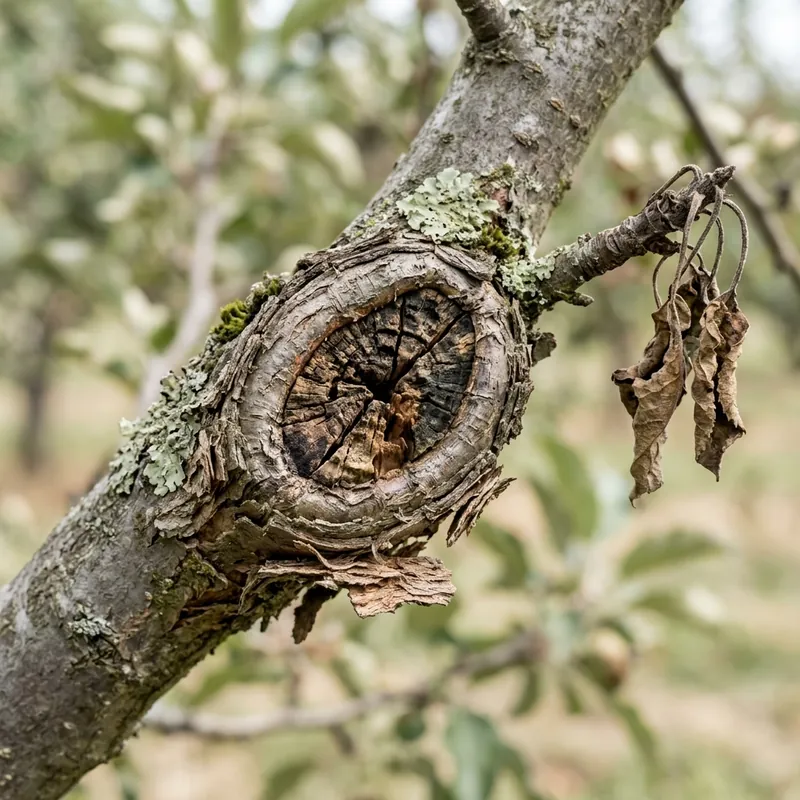
Short answer: Apple and pear canker is a fungus that kills patches of bark, usually starting at a bud, leaf scar or pruning cut. The giveaway is a sunken, cracked, often target-like patch of bark with raised edges, and dead twigs above it. On a dry day, cut cankered shoots and spurs back to healthy wood, and pare away diseased bark on thick branches.
What it looks like
- Sunken, cracked, oval or round patches of dead bark, often around a bud or old wound
- Rings in the dead bark like a target, on older cankers on bigger branches
- Raised, swollen edges where the tree tries to grow bark back over the wound
- Twigs and spurs that die above a canker that has circled them
- Tiny white pustules at the canker edge in summer, and small red dots on the canker
- Bark that flakes off infected twigs
- Young fruit that rots and falls
Is it apple and pear canker or something else?
| Could also be | How to tell |
|---|---|
| Fire blight | Fire blight starts in the blossoms and young shoots in spring, which turn brown or black and hook over at the tip. Apple canker starts as a sunken patch of bark around a bud or wound and moves slowly over seasons. |
| Coral spot | Coral spot covers dead twigs with pinhead-sized pink or coral orange cushions. Apple canker shows target-like sunken bark, with tiny white or red dots only at the edges. |
Why it happens
Apple canker is caused by a fungus that releases spores from old cankers. In summer they spread in splashing water, and in winter and spring the wind carries them. They get in through wounds: pruning cuts, leaf scars in fall, frost cracks, scab spots and damage from woolly aphids.
On small branches and fruit spurs, a canker can circle and kill the shoot within one season. On thick branches and the trunk it grows more slowly and can last for years, which is where the target-like rings come from.
Canker is worst on wet, heavy or acidic soil, where trees grow poorly and heal slowly. Some apple varieties are much more prone than others, and no variety is fully resistant.
How to fix it
- Cut out cankered shoots and spurs on a dry day. Remove small cankered shoots and fruit spurs completely, cutting back to healthy wood below the canker. Do it in dry weather so the cuts don't pick up new spores.
- Pare away diseased bark on thick branches. On branches too big to remove, use a sharp knife to cut away the dead, sunken bark and the wood under it until you reach clean, green tissue all around.
- Get rid of prunings and clean your tools. Put the cut wood in the trash or burn it where allowed. Disinfect pruners and knives with rubbing alcohol between trees.
- Improve drainage. Canker is worst on wet, heavy soil. Open up compacted ground, avoid planting new trees in low, soggy spots, and have the soil tested if you suspect it is acidic.
Watch out: Small cankers left on young shoots spread into the main branches. Check the tree each winter and cut new ones out early.
How to prevent it
- Look over apple and pear trees every winter, when cankers are easy to see
- Prune on dry days and make clean cuts close to a bud
- Control scab and woolly aphids, whose damage lets the fungus in
- Plant in well-drained soil and avoid wet, heavy ground
- Choose varieties that show some resistance when you plant new trees
Plants it often affects
- Apple the main host; spurs and young shoots die back from cankers
- Pear gets the same sunken, cracked cankers
- Crabapple an apple relative that can carry cankers
- Mountain ash also attacked, with cankers on branches
Questions people ask
Can an apple tree recover from canker?
Yes, if you keep cutting out cankers while they are small. Cankers on the trunk or main branches are harder, since a canker that circles a limb kills everything above it. Regular winter checks stop most of them early.
Is apple canker the same as fire blight?
No. Fire blight is a bacterial disease that strikes blossoms and young shoots in spring and makes them look scorched. Apple canker is a fungus that kills patches of bark around buds and wounds and spreads slowly over years.
Why does my apple tree keep getting canker?
Wet, heavy or acidic soil is the usual reason, along with a prone variety. Scab and woolly aphids also make wounds that let the fungus in. Improving drainage and dealing with those problems cuts down new cankers.

Not sure it's apple and pear canker?
Take a photo in Liana and the health check names the problem and tells you what to do first. Liana also reminds you to check the soil, so watering mistakes don't start. Get Liana for iPhone.
Sources
- Royal Horticultural Society, Apple canker
- University of California IPM, Nectria Canker