Caterpillars on plants: how to find and stop them
Caterpillars on plants chew large, ragged holes in leaves, and the small dark droppings below are often the first clue. Most do little harm, but cabbage worms can riddle a row of kale or broccoli, and box tree moth caterpillars can strip a boxwood in days. Picking them off and covering crops handles most problems.
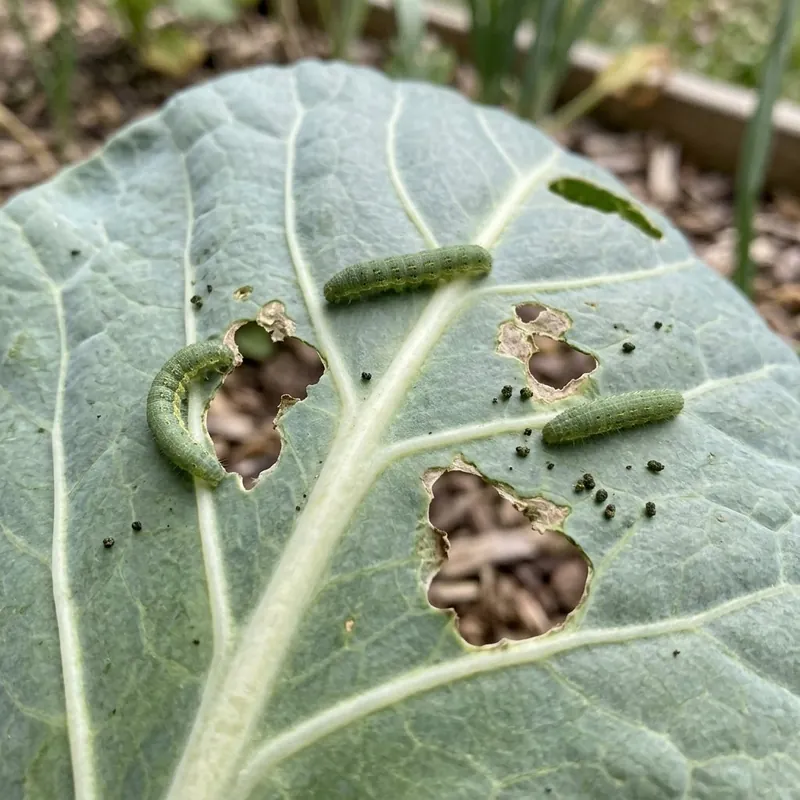
Short answer: Caterpillars are the young of moths and butterflies, and many of them chew holes in leaves. The giveaway is ragged holes with small dark droppings on the leaves or soil below. Check the undersides of leaves and pick off what you find, then cover cabbage-family crops with fine netting so no new eggs get laid.
What it looks like
- Large, ragged holes in leaves, sometimes eaten down to the main vein
- Small dark green or brown droppings on lower leaves or on the soil below
- Green caterpillars lying along the veins on leaf undersides, where they're easy to miss
- White butterflies fluttering over cabbage, kale or broccoli
- Tiny yellowish eggs stuck to the undersides of leaves
- Caterpillars tunneling into the heads of cabbage or broccoli
- On boxwood, wispy silk webbing inside the shrub and leaves turning brown and see-through
Is it caterpillars or something else?
| Could also be | How to tell |
|---|---|
| Slugs and snails | Slugs and snails also chew ragged holes, but they leave shiny slime trails and feed mostly at night or after rain. Caterpillars leave droppings instead of slime, and you can usually find them on the plant by day. |
| Sawfly larvae | Sawfly larvae look like caterpillars but have more than five pairs of fleshy legs along the belly, and they often feed in groups. True caterpillars have five pairs or fewer. |
| Flea beetles | Flea beetles pepper leaves with many tiny round holes and jump away when you touch the plant. Caterpillar holes are bigger and ragged. |
Why it happens
Caterpillars hatch from eggs that moths and butterflies lay on the plants their young eat. The white butterflies you see over the vegetable garden in warm weather are laying eggs on cabbage, kale, broccoli, turnips and their relatives. Their caterpillars, called imported cabbageworms, are velvety green with a thin yellow stripe down the back. They chew small holes that widen until little is left but the midrib.
Butterflies and moths keep laying while the weather is warm, so new caterpillars can turn up all season. Young ones are tiny and stay on the undersides of leaves, which is why the damage often seems to appear overnight.
Box tree moth is a newer pest in the United States, now found on boxwood in a number of eastern and midwestern states. Its green-and-yellow caterpillars hide in silk webbing inside the shrub, and two to five overlapping generations a year let the damage build quickly.
How to fix it
- Pick them off by hand. Turn leaves over and look along the veins, where green caterpillars blend in. Pick them off and drop them into a bucket of soapy water. Check again every few days, since new ones keep hatching.
- Rub off the eggs. Look under the leaves of cabbage-family plants for tiny yellowish eggs, laid one at a time or in small yellow clusters depending on the butterfly. Rub them off with your thumb before they hatch.
- Cover cabbage-family crops with fine netting. Put fine netting or floating row cover over cabbage, kale, broccoli and turnips at planting, before the butterflies arrive. Bury or weigh down the edges so nothing can slip underneath.
- Let birds and other predators help. Birds feed caterpillars to their young, and wasps and other insects hunt them too. Skip broad-spectrum sprays, which kill these helpers along with the pests.
- On boxwood, check for webbing and report box tree moth. Look inside the shrub for silk webbing, light green-brown droppings and green-and-yellow caterpillars with black heads. Parts of the US have quarantines for box tree moth, so send photos to your local extension office or state agriculture department to confirm it. Pick off or prune out small infestations.
Watch out: Many caterpillars feed lightly and grow into moths and butterflies. Only step in when the damage is spreading.
How to prevent it
- Cover cabbage-family crops with netting or row cover from the day you plant them.
- Check leaf undersides for eggs and young caterpillars whenever you're in the garden.
- Clear away old cabbage-family plants after harvest, so caterpillars have nowhere to spend the winter.
- Inspect new boxwoods for webbing and caterpillars before you plant them.
- Avoid broad-spectrum insecticides, which kill the predators that keep caterpillars in check.
Plants it often affects
- Cabbage outer leaves chewed full of holes, and caterpillars can bore into the head
- Broccoli green caterpillars hide along the stems and can tunnel into the heads
- Kale holes widen until only the midribs are left
- Turnip leaves riddled with holes by cabbageworms
- Boxwood box tree moth caterpillars web the shrub and strip it in parts of the eastern US
Questions people ask
What are the green caterpillars on my cabbage?
Most likely imported cabbageworms, the young of the white butterflies with black wing tips that flutter over vegetable gardens. They're velvety green with a thin yellow stripe down the back and grow to about an inch and a quarter. They feed on cabbage, broccoli, kale, turnips and their relatives.
Should I kill every caterpillar I find?
No. Most caterpillars feed lightly and grow into moths and butterflies, and a few chewed leaves won't hurt a healthy plant. Step in on cabbage-family crops and boxwood, where damage can spread fast.
What is making webs in my boxwood?
Webbing plus chewed or missing leaves on boxwood points to box tree moth, a newer invasive pest in parts of the US. Look for green-and-yellow caterpillars with black heads inside the webbing. Send photos to your local extension office before you treat, since some areas are under quarantine.

Not sure it's caterpillars?
Take a photo in Liana and the health check names the problem and tells you what to do first. Liana also reminds you to check the soil, so watering mistakes don't start. Get Liana for iPhone.
Sources
- University of Maryland Extension, Imported Cabbageworm on Vegetables
- University of Maryland Extension, Box Tree Moth