Sawfly larvae: how to spot them and save your shrubs
Sawfly larvae look like caterpillars and feed in hungry groups, and they can strip gooseberries, currants, roses and Solomon's seal to bare stems in a few days. On currants and gooseberries the usual culprit is called the imported currantworm in the US and the gooseberry sawfly in Britain. Plants usually leaf out again, and picking the larvae off keeps most outbreaks small.
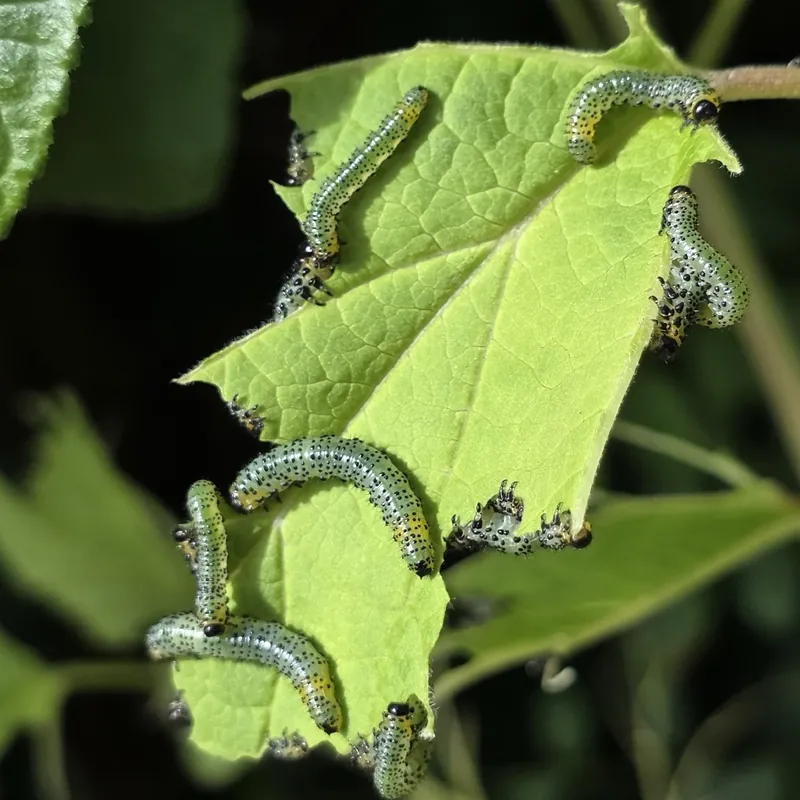
Short answer: Sawfly larvae are the young of small insects related to wasps. They look like caterpillars but have more than five pairs of fleshy legs along the belly. If a gooseberry or currant is losing leaves from the center of the bush outward, look under the lower leaves for green larvae and pick them off or shake them onto a sheet.
What it looks like
- Leaves eaten from the edges inward, often down to the main veins
- Damage that starts low in the center of a gooseberry or currant bush and spreads up and out
- Groups of green larvae, often with black spots and dark heads, feeding side by side
- Bare stems where a full bush stood a few days earlier
- Rows of tiny pale eggs along the veins on the undersides of leaves
- On roses, leaves eaten down to a thin, see-through skin
Is it sawfly larvae or something else?
| Could also be | How to tell |
|---|---|
| Caterpillars | Caterpillars have five or fewer pairs of fleshy legs on the belly. Sawfly larvae have more, and they often have shiny black or red heads. |
| Slugs and snails | Rose sawfly larvae are nicknamed roseslugs because they look slimy, but they stay on the leaves by day and leave no slime trail. Real slugs feed mostly at night and leave shiny trails. |
| Japanese beetles | Japanese beetles also eat rose leaves down to a lacy skeleton, but they're shiny metallic green-and-copper beetles you can see from a distance. Sawfly larvae are soft, green and caterpillar-like. |
Why it happens
Adult sawflies are small flying insects related to wasps. Females lay their eggs on the undersides of leaves, and on gooseberries they choose leaves low in the middle of the bush, where nobody looks. The young larvae feed unseen and only get noticed once they've eaten their way up and out.
The common gooseberry sawfly can have three broods a year, and some related species up to four. A bush you cleared in spring can be stripped again in summer.
Different sawflies feed on different plants. Roses, hibiscus relatives, dogwoods and pines each have their own, and Solomon's seal has a sawfly of its own too.
How to fix it
- Pick off the larvae or shake them onto a sheet. Pick the larvae off by hand and drop them into soapy water. On a bigger bush, spread an old sheet underneath and shake the branches, then gather up what falls. A firm spray of water also knocks small larvae off, and they can't climb back up.
- Look in the center of currant and gooseberry bushes from mid-spring. Part the branches and check the lower leaves in the middle of the bush, where the first larvae feed. A few leaves with small holes are the early sign.
- Check leaf undersides for eggs. Turn leaves over and look for rows of tiny pale eggs along the veins. Rub them off, or pick off the leaf if it's covered.
- Let birds and beetles help. Birds, wasps and ground beetles all eat sawfly larvae. Skip broad-spectrum sprays, which kill them too.
- Keep checking for new broods. A bare bush usually grows new leaves, though the crop may be smaller that year. Look it over every week or so, because new broods hatch through summer.
Watch out: Sawflies come back in two or three broods a year. Keep checking until fall, even after you've cleared one batch.
How to prevent it
- Check the middle of gooseberry and currant bushes every week from mid-spring.
- Prune bushes to an open center so you can see inside them easily.
- Encourage birds and ground beetles, which eat the larvae.
- Avoid broad-spectrum insecticides, which harm bees and the natural enemies that keep sawflies down.
Plants it often affects
- Gooseberry the classic host; larvae start low in the center of the bush
- Red currant the same sawfly strips red and white currants
- Rose roseslugs eat the leaves down to a see-through skin
- Solomon's seal its own sawfly can strip the leaves to bare stems
- Rose of Sharon hibiscus sawfly larvae leave the leaves lacy
Questions people ask
Are sawfly larvae caterpillars?
No. They look alike, but sawfly larvae have more than five pairs of fleshy legs on the belly, and caterpillars have five or fewer. The difference matters, because Bt (a bacterial spray for caterpillars) doesn't work on sawfly larvae.
Will my gooseberry bush recover after sawflies?
Usually, yes. Bushes survive being stripped bare and grow new leaves, though that year's crop may be smaller. A badly weakened bush can also give a poor crop the following year, so catch the next broods early.
When do sawfly larvae appear?
On gooseberries and currants the first larvae show up from mid-spring, and more broods follow through summer into early fall. Check the center of the bush every week or so during that time.

Not sure it's sawfly larvae?
Take a photo in Liana and the health check names the problem and tells you what to do first. Liana also reminds you to check the soil, so watering mistakes don't start. Get Liana for iPhone.
Sources
- Royal Horticultural Society, Gooseberry sawfly
- University of Maryland Extension, Sawflies in Home Gardens