Crown gall: what the lumps mean and what to do
Crown gall is a bacterial disease that makes rough, rounded lumps at the base of the stem or on the roots of roses, fruit trees, euonymus and many other plants. The bacterium lives in the soil and gets in through wounds. There is no cure, but many plants with galls keep growing well for years.
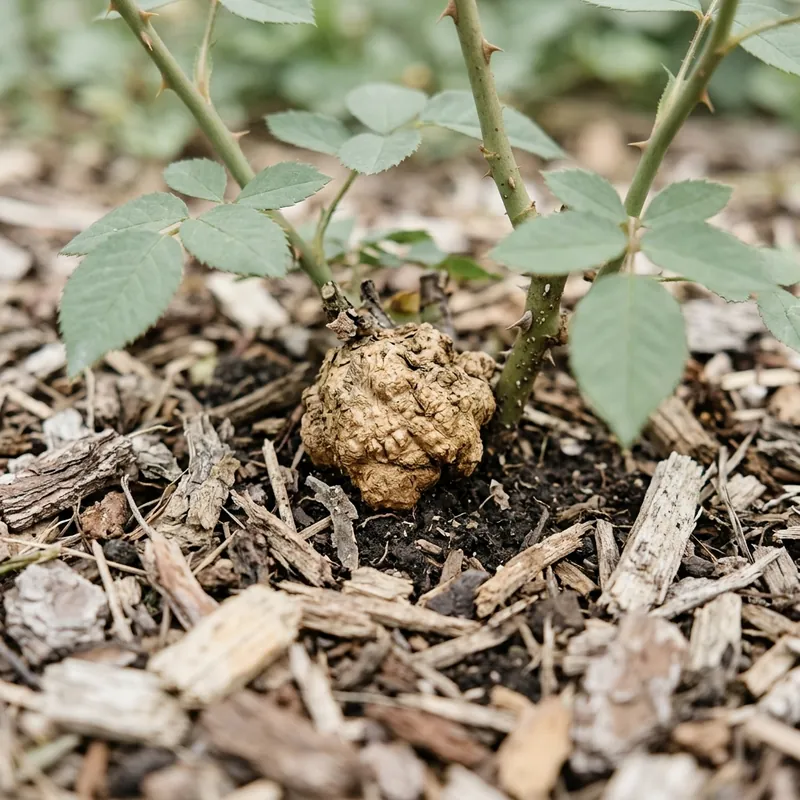
Short answer: Crown gall is caused by a soil bacterium that enters through wounds and makes plant cells grow into lumps. The giveaway is rough, knobbly, often crumbly swellings at or just below the soil line, or on the roots. There is no cure: leave a plant that is growing well, and dig out and throw away one that is stunted.
What it looks like
- Rough, rounded, knobbly lumps at the stem base, at or just below the soil line
- Galls on the roots, found when you dig or repot
- Lumps from pea-sized to several inches across
- Galls on woody plants that are hard and stay for years, while galls on soft plants rot away
- A stunted plant with small, yellowish leaves and fewer flowers or fruit
- Galls higher up on stems or branches of some woody plants
Is it crown gall or something else?
| Could also be | How to tell |
|---|---|
| Graft union | Roses and fruit trees often have a smooth, swollen knuckle at the base where the variety was grafted onto the roots. It is even and part of the stem. Crown galls are rough, crumbly lumps, often on the roots. |
| Root-knot nematodes | Root-knot nematodes make many small, bead-like swellings along the fine roots. Crown galls are fewer, larger, rougher lumps, usually at the crown or on bigger roots. |
| Root nodules on peas and beans | Peas, beans and their relatives carry small, round nodules on their roots that hold helpful nitrogen-fixing bacteria. They are normal, and the plant is healthy. |
Why it happens
Crown gall is caused by a bacterium that lives in the soil and on infected roots. It can only get into a plant through a wound, such as a pruning cut, a nick from a spade, mower or string trimmer, frost cracks or damage from soil pests. Once inside, it makes the plant's cells grow out of control into a gall.
Galls can appear within weeks of infection or take a year or more. Because they block the flow of water and food, a badly galled young plant can be stunted, while a large, established plant may show no harm at all.
The bacteria spread in moving soil, water and infected plants. Nursery plants with galls on their roots are a common way it reaches a garden.
How to fix it
- Leave a healthy plant, remove a stunted one. If the plant is growing and flowering well, leave it be, since cutting galls off rarely helps. If it is stunted or failing, dig it out with as many roots as you can and put it in the trash.
- Disinfect tools after touching galls. Clean pruners and spades with rubbing alcohol or a household disinfectant before you use them on another plant, so you don't carry the bacteria with you.
- Avoid nicking stem bases. Keep spades, mowers and string trimmers away from the base of roses and fruit trees. A ring of mulch around the base helps keep the mower back.
- Don't replant related plants in that spot. Keep roses, fruit trees and their relatives out of the spot where an infected plant grew. Grass, or vegetables that don't get crown gall, for a few years helps the soil recover.
Watch out: The swollen graft union at the base of roses and fruit trees is normal. Crown galls are rough, crumbly lumps, often on the roots.
How to prevent it
- Check the roots and crown of new plants for lumps before you buy or plant them
- Avoid wounding stems and roots when planting, weeding and mowing
- Clean tools after working on a plant with galls
- Plant in well-drained soil and don't move soil from an infected spot
- Choose plants that don't get crown gall for spots where it has been
Plants it often affects
- Rose galls at the graft or crown, sometimes on the roots
- Euonymus a common host, with galls at the base of the stems
- Apple galls on the roots and crown, mostly in young trees
- Peach stone fruit trees get galls at the soil line
- Grape galls on the trunk, often after winter cold damage
- Raspberry brambles get galls on the roots and crown
Questions people ask
Can you cure crown gall?
No. Once galls form, the plant stays infected. Cutting galls off rarely helps, since new ones can form elsewhere. A plant that still grows well can be left alone, and a stunted one is best removed.
Can I plant something else where a plant had crown gall?
Yes, as long as it is a plant that doesn't get crown gall. Grass for a few years helps the soil recover. Avoid roses, fruit trees, brambles and grapes in that spot.
Is crown gall contagious to other plants?
It can spread through soil, water, infected plants and dirty tools, but only into plants that have a wound. Neighboring plants often stay healthy. Cleaning your tools and avoiding nicks at the stem base protect them.

Not sure it's crown gall?
Take a photo in Liana and the health check names the problem and tells you what to do first. Liana also reminds you to check the soil, so watering mistakes don't start. Get Liana for iPhone.
Sources
- University of Wisconsin-Madison Extension, Crown Gall
- Royal Horticultural Society, Crown gall