Cyclamen mites: the hidden cause of twisted new growth
Cyclamen mites on houseplants are far too small to see, so you notice them by what they do. New leaves come out small, twisted and brittle, and flower buds stay shut. African violets, cyclamen and begonias are the usual victims, and since the mites are hard to get rid of, the goal is to keep them from reaching your other plants.
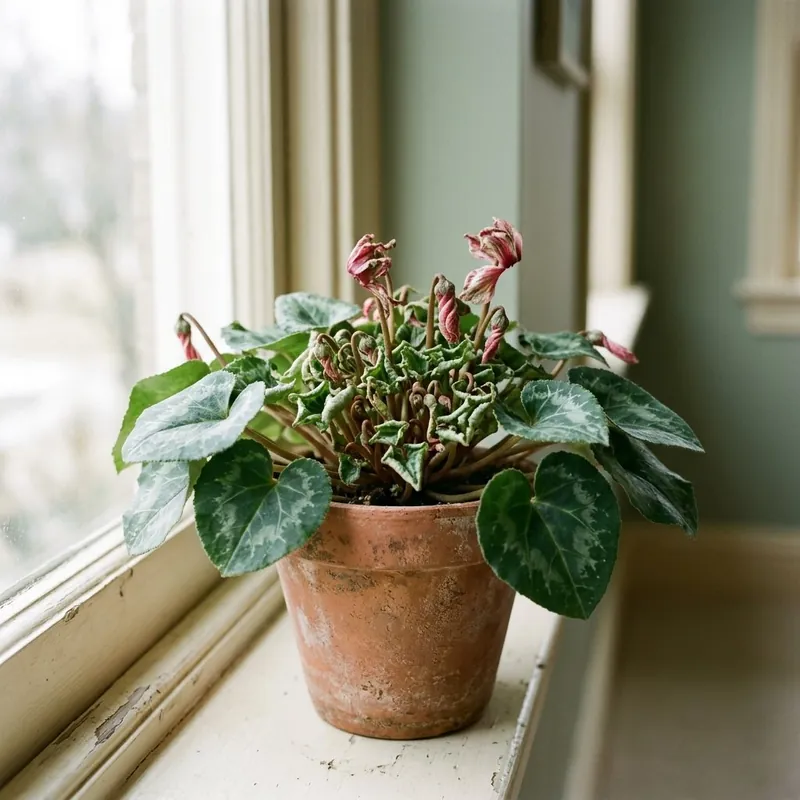
Short answer: Cyclamen mites are microscopic mites that feed deep in buds and the growing center of a plant. The giveaway is young leaves bunched at the center that stay small and crinkled and never open flat, often with buds that fail to open. Move the plant away from others today, cut off the distorted growth, and wash your hands before you touch anything else.
What it looks like
- Young leaves bunched tightly at the center of the plant, small and crinkled, never opening flat
- New leaves that feel thick, stiff or brittle
- Flower buds that stay closed, turn brown or drop
- Flowers that open twisted or streaked
- A plant that stops growing from the center
- Older outer leaves that look normal while everything new is distorted
- No webbing and no visible insects, even when you look closely
Is it cyclamen mites or something else?
| Could also be | How to tell |
|---|---|
| Cold damage | Cold leaves dark, limp or water-soaked patches on leaves that had already opened, often after a chilly window or draft. Mites distort the new growth at the center, and it keeps coming out wrong. |
| Nutrient deficiency | A hungry plant yellows evenly or between the veins, usually starting on older leaves. Cyclamen mites leave the old leaves alone and twist the new ones. |
| Thrips | Thrips also streak flowers and distort leaves, but you can see them: slim insects that move, plus silvery patches and black specks on the leaves. Cyclamen mites can't be seen without strong magnification. |
Why it happens
Cyclamen mites live in the tightest, most sheltered spots on a plant: folded young leaves, buds and the crown. Their saliva is toxic to the plant, so the growth they feed on comes out twisted, hardened and stunted.
They don't fly or spin webs. They move on hands, tools and clothing, and across from one plant to the next where leaves touch. They often arrive on a new plant that looked fine when you bought it.
Because they hide so deep in the plant, sprays rarely reach all of them. That's why extension services usually advise throwing out badly infested plants.
How to fix it
- Isolate the plant today. Move it to a room with no other plants. The mites spread by touch, so keep it away from anything its leaves could brush against.
- Cut off and throw away all distorted growth. Snip out twisted leaves and deformed buds and flowers, and put them straight into a bag in the trash, not the compost. Clean the scissors before you use them anywhere else.
- Throw out badly affected plants. If the whole center is crinkled, bag the plant and put it in the trash. The mites hide deep in the crown, where trimming can't reach them all.
- Wash your hands and tools. Wash your hands, scissors and anything else that touched the plant before going near your other plants. Do the same every time you check it.
- Watch nearby plants for a few weeks. Check the plants that stood close by for bunched, crinkled new leaves over the next several weeks. Catching a second plant early limits the damage.
Watch out: This damage often gets blamed on cold or fertilizer. Crinkled young leaves bunched at the center that never open flat point to mites.
How to prevent it
- Keep new plants, especially African violets, cyclamen and begonias, apart from your others for several weeks and watch their new growth.
- Wash your hands after handling a plant you're unsure about.
- Space plants on crowded windowsills so their leaves don't touch.
- Choose plants with flat, evenly colored new leaves at the center.
Plants it often affects
- African violet the houseplant hit most often; center leaves bunch up and turn stiff
- Cyclamen the mite's namesake; leaves curl and buds fail to open
- Begonia new leaves twist and buds die early
- Gloxinia a common host; growing points twist and curl
- Strawberry young leaves stay small and crinkled in the crown
Questions people ask
Can you see cyclamen mites?
Not with the naked eye. They're smaller than spider mites and hide in buds and folded leaves, so even a hand lens rarely shows them. You usually recognize them by the damage: twisted, stunted new growth at the center of the plant.
Can a plant with cyclamen mites be saved?
Sometimes, if you catch it early and cut out all the distorted growth. Mites deep in the crown are very hard to reach, so extension services usually recommend throwing out infested plants. For a cheap or easily replaced plant, that's the safest choice for the rest of your collection.
Are cyclamen mites the same as spider mites?
No. Spider mites feed on the undersides of leaves, leave pale speckles and often spin fine webbing. Cyclamen mites hide in buds and new growth, spin no webbing and leave twisted, distorted leaves instead.

Not sure it's cyclamen mites?
Take a photo in Liana and the health check names the problem and tells you what to do first. Liana also reminds you to check the soil, so watering mistakes don't start. Get Liana for iPhone.
Sources
- University of Wisconsin-Madison Extension, Cyclamen and Broad Mites
- Colorado State University Extension, Managing Houseplant Pests