Gall mites on leaves: which to ignore and which to act on
Gall mites are mites far too small to see that make plants grow felty patches, pimples or tiny nail-shaped galls on their leaves. On linden, maple, walnut and many other trees they're harmless. Two kinds do real damage in the garden: fuchsia gall mite and black currant big bud mite.
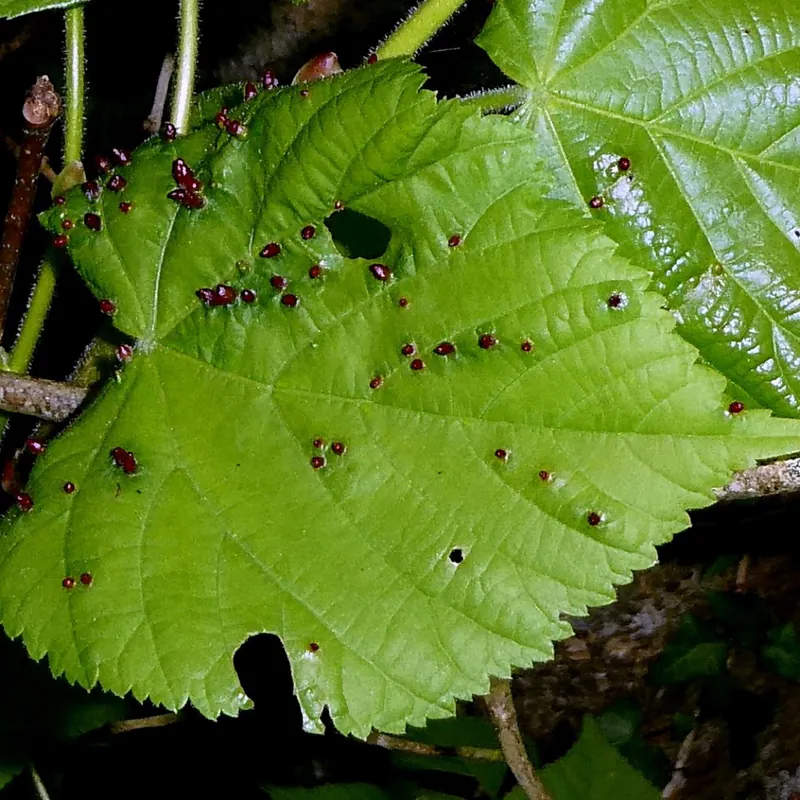
Short answer: Gall mites are microscopic mites that make leaves grow odd lumps: upright red or green nail galls, small pimples, or felty patches of hairs. On trees and shrubs these do no harm and can be left alone. On fuchsias, cut off twisted shoot tips, and on black currants, pick off swollen round buds in winter.
What it looks like
- Small upright nail-shaped or pointed galls on the upper side of leaves, often red or green
- Raised pimples or blister-like bulges scattered across the leaf
- Felty patches of dense hairs, usually under the leaf, pale at first and later brown
- Thickened, rolled leaf edges
- On fuchsias, swollen, twisted shoot tips with yellow-green or reddish leaves and deformed flowers
- On black currants, buds that swell up round in late winter instead of staying slim and pointed
Is it gall mites or something else?
| Could also be | How to tell |
|---|---|
| Galls from wasps and midges | Insect galls such as oak apples are usually bigger, single lumps or balls on leaves, buds and stems. Mite galls are tiny and come in crowds: dozens of nails or pimples, or a felty patch. |
| Rust | Rust pustules are powdery and leave orange or brown dust on your finger. Felty mite patches are made of plant hairs and don't rub off as powder. |
| Cyclamen mites | Cyclamen mites stunt and twist new growth on cyclamen, African violets and other indoor plants without making galls. Gall mites raise lumps, nails or felt on the leaves, mostly on garden trees and shrubs. |
Why it happens
Gall mites (eriophyid mites) feed on leaf and bud tissue, and chemicals in their saliva make the plant grow a gall around them. The gall shelters the mites while they feed and breed.
Each kind of gall mite usually lives on one host plant. Most do no lasting harm, and the galls are part of a healthy garden. The two to watch are fuchsia gall mite, which distorts shoot tips, and black currant big bud mite, which destroys buds and can spread reversion.
They move short distances on the wind and by riding on insects, and further on cuttings and nursery plants.
How to fix it
- On trees and shrubs, leave them. Nail galls on linden, felty patches on maple and blisters on walnut leaves look odd but don't harm the tree. No treatment is needed, and sprays can't reach the mites inside the galls.
- On fuchsias, cut off twisted shoot tips. Snip off swollen, distorted tips well below the damaged part and put them in the trash or bury them. Regrowth may be hit again, so check the plant every few weeks.
- On black currants, pick off swollen buds in winter. In late winter, round, swollen buds are easy to tell from slim, pointed healthy ones. Pick them off on a lightly infested bush and throw them away, well away from your currants.
- Replace badly hit black currants. Dig up heavily infested bushes after harvest. Plant new, certified stock of a mite-resistant variety in a fresh spot in autumn.
Watch out: Big bud mites spread reversion, a virus-like disease that can leave black currants almost fruitless. Don't take cuttings or plants from bushes with swollen buds.
How to prevent it
- Buy black currants as certified stock, inspected free of big bud mite and reversion.
- Check new fuchsias for twisted, swollen tips before you buy them.
- Never take cuttings from fuchsias or black currants that show galls or swollen buds.
- Leave galls on trees alone, since spraying them does nothing useful.
Plants it often affects
- Linden small red nail galls on the upper side of the leaves
- Maple red pimples or felty patches on the leaves, harmless to the tree
- Walnut raised blisters and felt under the leaves
- Fuchsia swollen, twisted shoot tips and deformed flowers
- Black currant round, swollen buds in late winter that fail to open
Questions people ask
Are the red spikes on my maple or linden leaves harmful?
No. They're nail galls made by gall mites, and the tree carries on growing normally. You don't need to spray or strip the leaves; the galls fall with the leaves in autumn.
Can I save a fuchsia with gall mites?
Often, if you cut off every twisted tip and keep checking, since new growth may be hit again. A badly distorted plant that keeps getting hit is better thrown out before the mites spread to other fuchsias.
What causes swollen round buds on black currants?
Black currant big bud mite. The mites live and breed inside the bud, which swells up and fails to open properly. Pick the buds off in winter, and replace badly hit bushes with certified, resistant plants.

Not sure it's gall mites?
Take a photo in Liana and the health check names the problem and tells you what to do first. Liana also reminds you to check the soil, so watering mistakes don't start. Get Liana for iPhone.
Sources
- Royal Horticultural Society, Gall mites
- Royal Horticultural Society, Blackcurrant big bud mite