Rust on plants: orange bumps under the leaves
Rust on plants is a fungal disease named for the orange, rusty brown or yellow powder it makes, mostly on the undersides of leaves. Roses, hollyhocks, geraniums, snapdragons, mint and beans all get their own kinds. It is worst in damp weather, and its spores wait on fallen leaves for the next season.
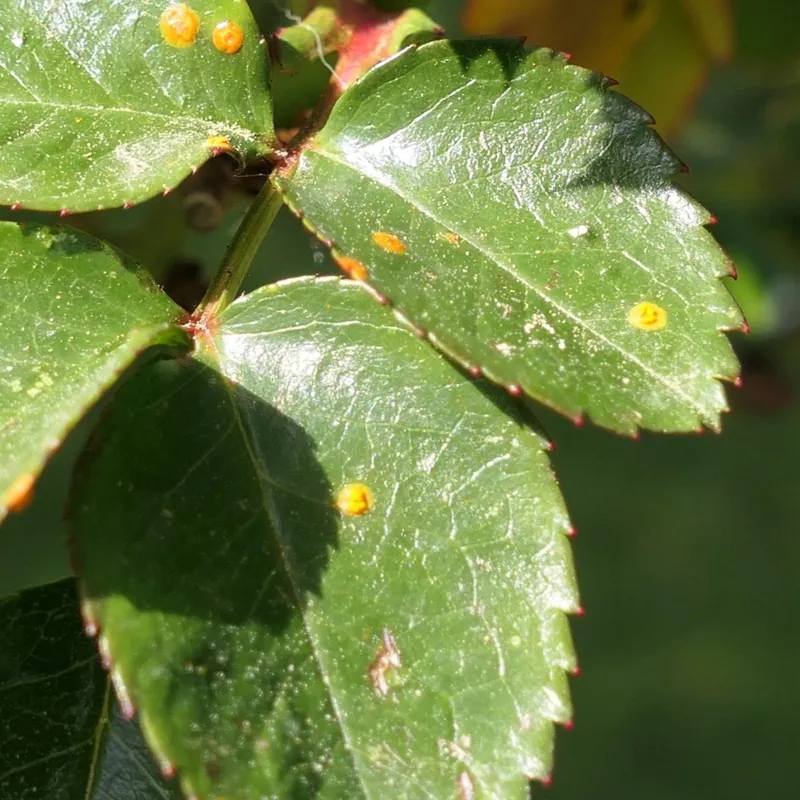
Short answer: Rust is a group of fungal diseases that form small, powdery orange, brown or yellow pustules, mostly under the leaves, with pale or yellow spots above them. Rub a pustule with a tissue: rust leaves a colored, dusty smear. Pick off infected leaves and throw them out, clear fallen leaves from around the plant and keep the foliage dry.
What it looks like
- Small raised bumps of orange, rusty brown or yellow powder on the undersides of leaves
- Pale yellow or orange spots on the upper side of the leaf, right above the bumps
- A colored dust that rubs off onto your finger or a tissue
- Pustules that darken to brown or black late in the season on some plants, such as roses
- Leaves that yellow, shrivel and drop early when badly infected
- Distorted shoots with bright orange spores on roses in spring
Is it rust or something else?
| Could also be | How to tell |
|---|---|
| Leaf spot disease | Leaf spots are flat brown or black patches in the leaf itself, with no powder to rub off. Rust forms raised pustules that leave orange or brown dust on your finger. |
| Spider mites | Mites leave tiny pale speckles all over the leaf and often fine webbing underneath. You won't find raised, powdery bumps. |
| Black spot on roses | Black spot makes black or purple spots with feathery edges on top of rose leaves and no powder underneath. Rose rust has orange pustules on the undersides. |
Why it happens
Rusts are fungi, and each kind attacks only a narrow range of plants. The rust on your roses won't move to your mint, and hollyhock rust stays on hollyhocks and their mallow relatives, including the weed common mallow. Some rusts need two unrelated plants to finish their life cycle, such as pear rust, which spends part of its life on juniper.
Infection needs leaves that stay wet for a long time, so rust is worst in wet summers, in crowded beds and where sprinklers wet the foliage. The powdery spores blow on the wind from plant to plant.
Plenty of nitrogen fertilizer makes it worse, because soft, lush growth is easy for the fungus to colonize. In late summer and fall, many rusts form tough resting spores on the leaves, which survive the winter on fallen leaves and old stems and start the next year's outbreak.
How to fix it
- Pick off infected leaves and throw them out. Remove leaves with pustules as soon as you see them and bag them for the trash. If most of the plant is affected, take only the worst leaves, since stripping a plant bare does more harm than good.
- Clear fallen leaves. Rake up and bag leaves that have dropped around the plant, especially in fall. Leaves from late in the season shouldn't go in the compost, since their resting spores survive it.
- Water at the base and keep leaves dry. Water the soil directly, early in the day, and switch off sprinklers that wet the foliage. Space plants out so leaves dry quickly after rain.
- Go easy on nitrogen. Hold back on high-nitrogen fertilizer while the plant is infected. Soft, lush growth rusts faster than firm, steady growth.
- Cut back at the end of the season. For hollyhocks and perennials, cut stems to the ground after flowering and bag the debris. On roses, prune out shoots with orange spores in spring as soon as you spot them.
Watch out: Rust spores spread on the wind and survive on fallen leaves. Leaving those leaves on the ground starts next year's outbreak.
How to prevent it
- Choose rust-resistant varieties where they exist, for roses, hollyhocks, snapdragons and beans
- Space plants for good airflow and keep sprinklers off the leaves
- Feed moderately, and avoid heavy nitrogen fertilizer
- Check new plants under the leaves before you buy them and keep them apart for a couple of weeks
- Pull common mallow near hollyhocks, and clean up fallen leaves every fall
Plants it often affects
- Rose orange pustules under the leaves that turn black by late summer; some varieties are far more prone
- Hollyhock yellow or orange spots on top and brown to reddish bumps under the lower leaves
- Geranium rings of brown pustules on leaf undersides, most often on zonal geraniums
- Snapdragon dark brown pustules under the leaves and on stems; leaves wither in wet seasons
- Mint swollen, twisted shoots in spring, then orange pustules on the leaves
- Bean rusty brown pustules on the leaves in warm, humid spells
Questions people ask
Can rust spread from one plant to another?
Yes, the spores blow on the wind, but each rust only infects its own group of plants. Rust on roses spreads to other roses, not to your beans or mint. That's why one bed can be badly hit while plants next to it stay clean.
Can I compost leaves with rust?
Leaves from spring and early summer can usually go in the compost if they are left to break down fully. Leaves from late summer and fall carry tough resting spores, so bag those for the trash.
Will a plant with rust die?
Most survive, though a bad attack weakens them and makes leaves drop early. Some plants, such as hollyhocks and snapdragons, can be badly hurt in wet seasons. Clearing infected leaves and keeping foliage dry usually keeps it to a nuisance.

Not sure it's rust?
Take a photo in Liana and the health check names the problem and tells you what to do first. Liana also reminds you to check the soil, so watering mistakes don't start. Get Liana for iPhone.
Sources
- Royal Horticultural Society, Rust diseases
- University of Illinois Extension, How to grow and care for hollyhocks