Mushrooms in houseplant pots: harmless and easy to handle
Mushrooms in houseplant pots are a common surprise, often small, bright yellow and gone within a few days. They grow from a fungus that feeds on dead matter in the potting mix and leaves your plant alone. Their arrival tells you the soil is staying warm and damp.
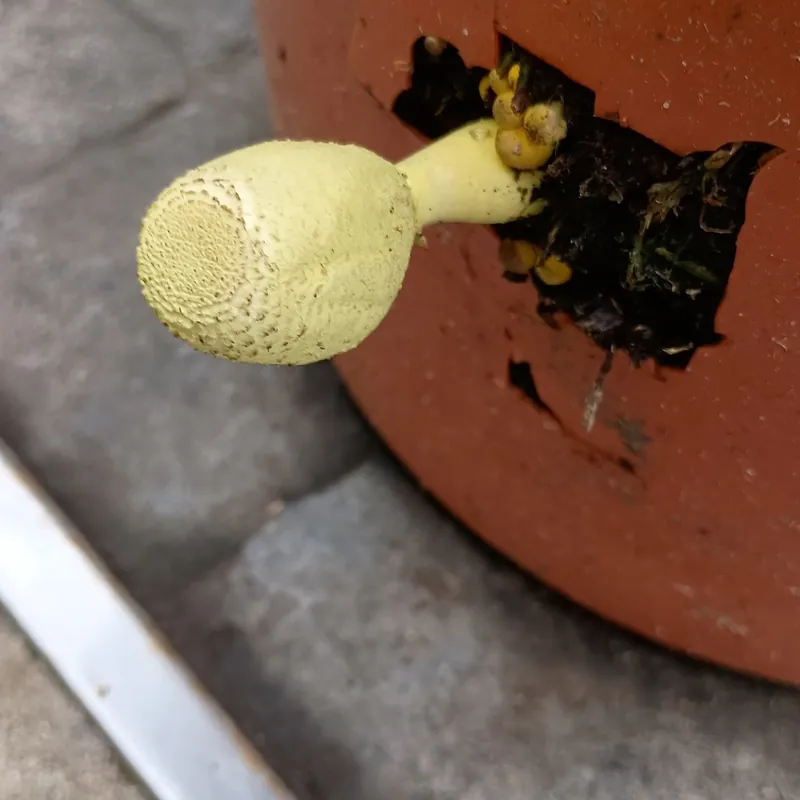
Short answer: The small yellow or pale mushrooms that pop up in pots come from a fungus living on dead material in the potting mix. They don't harm the plant. Pick them off whole, keep the pot away from children and pets, and let the top inch or two of the mix dry before you water again.
What it looks like
- Small mushrooms, often lemon yellow, with oval or bell-shaped caps about 1 to 2 inches across
- Mushrooms that appear suddenly, alone or in clusters, and wilt within a few days
- Fine white threads in the potting mix when you scratch the surface
- Crops of mushrooms after the pot has stayed damp in a warm, humid room
- A plant that looks fine otherwise, with firm stems and new leaves
Is it mushrooms in houseplant pots or something else?
| Could also be | How to tell |
|---|---|
| Mold on the soil | Soil mold is a flat white fuzz or cobweb across the surface, with no caps or stems. Both mean the mix is staying damp, and neither harms the plant. |
| Slime mold | Slime mold forms a soft, foamy or slimy blob that later dries into a crust of dark powder. It has no caps or gills. |
| Root rot | With root rot, the plant itself is sick: leaves yellow or wilt, stems go soft at the base and the soil may smell sour. Mushrooms on a plant that looks healthy are not a sign of rot. |
Why it happens
The most common houseplant mushroom is the yellow houseplant mushroom, also called the flower pot parasol. Its fungus lives as fine threads through the potting mix, breaking down bark, peat and other dead plant matter. The threads can arrive in a bag of potting mix, or spores can drift in on the air.
The fungus stays hidden most of the time. It sends up mushrooms only when conditions suit it: warmth, high humidity and soil that stays moist. Mushrooms that keep coming back are a sign the mix is wetter than the plant needs, which is worth fixing for the plant's sake too.
How to fix it
- Pick the mushrooms off whole. Lift each mushroom out at the base, stem and cap together, and put them in the trash. Wash your hands afterward.
- Keep the pot out of reach of children and pets. Move the plant somewhere they can't get to until no more mushrooms appear, and check it every day or two for new ones.
- Let the top of the mix dry between waterings. Push a finger into the soil and water only when the top inch or two feels dry. Empty the saucer after watering so the pot doesn't sit in water.
- Check the plant itself. Firm stems, steady color and new leaves mean the plant is fine. If it is also wilting or yellowing, look at the roots for rot, which is a separate problem.
Watch out: Pulling the plant out to hunt for the fungus only disturbs its roots. The fine threads run through all the potting mix and do no harm.
How to prevent it
- Check the soil before you water instead of watering on a fixed day
- Use pots with drainage holes and empty saucers after watering
- Give the plant some light and moving air, since a stuffy, humid corner suits the fungus
- When you repot, use fresh potting mix that drains well
Plants it often affects
- Peace lily kept evenly moist, so its mix often suits the fungus
- Boston fern damp mix and humid air bring up crops of small mushrooms
- Calathea moist, peaty mix and warm rooms are what the fungus likes
- Fiddle-leaf fig large pots of rich mix stay damp for days after watering
Questions people ask
Are mushrooms in houseplant soil bad for the plant?
No. The fungus feeds on dead matter in the potting mix and leaves living roots alone. It may even help by breaking down the mix and releasing nutrients. Treat the mushrooms as a sign to let the soil dry a little more.
Should I repot a plant that has mushrooms?
You don't need to. The fungus lives all through the mix, so it can come back even after repotting, and the plant isn't harmed. Repot only if the plant needs it anyway or the mix stays soggy and drains badly.
Will a fungicide get rid of mushrooms in my pots?
Fungicides generally don't work against them. Drier soil and moving air make mushrooms appear less often, and they fade on their own when conditions change.

Not sure it's mushrooms in houseplant pots?
Take a photo in Liana and the health check names the problem and tells you what to do first. Liana also reminds you to check the soil, so watering mistakes don't start. Get Liana for iPhone.
Sources
- Iowa State University Extension and Outreach, Will yellow mushrooms harm my houseplant?
- Penn State Extension, The Invasion of the Flower Pot Parasol