Japanese beetles: how to protect your plants
Japanese beetles are metallic green and copper beetles that arrive in early summer and chew leaves down to a lacy skeleton. They also eat flower buds, petals and fruit, with roses and grapes among their favorites. Picking them off early and often keeps the damage down.
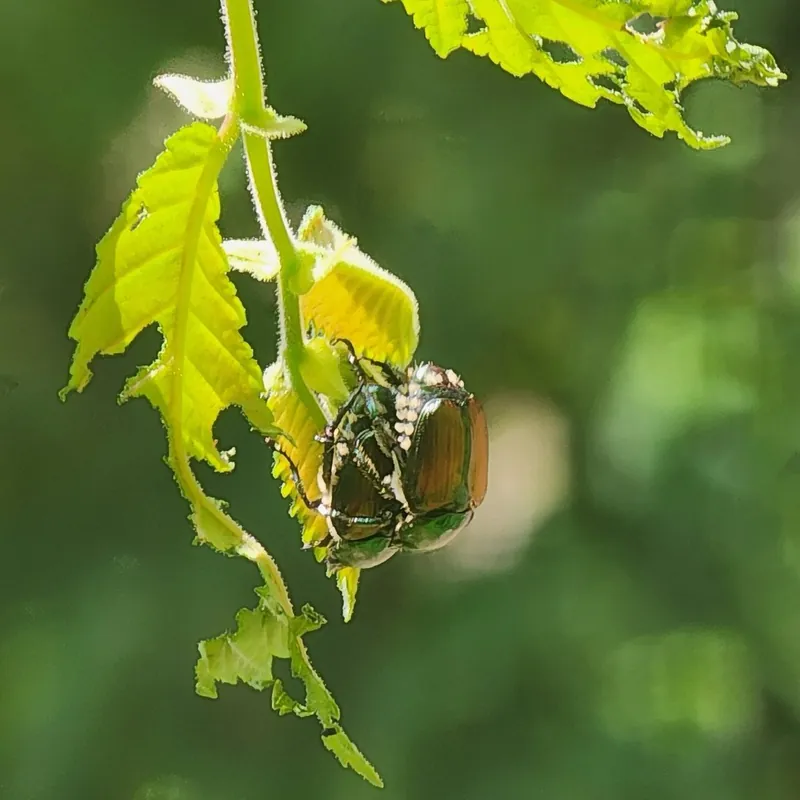
Short answer: Japanese beetles are shiny beetles about 3/8 inch long, with a metallic green body and copper wing covers. The giveaway is leaves eaten between the veins until only a lace-like skeleton remains, often with groups of beetles feeding together. Shake them into a bucket of soapy water early in the morning, and check again every day.
What it looks like
- Leaves eaten between the veins, leaving a lacy skeleton
- Groups of shiny metallic green and copper beetles feeding together
- Rose buds and open flowers chewed ragged
- Damage that starts in early summer and builds over the following weeks
- Beetles that drop to the ground when you reach for them
- Brown, dead patches in a nearby lawn in late summer or autumn, where the grubs feed on grass roots
Is it japanese beetles or something else?
| Could also be | How to tell |
|---|---|
| Sawfly larvae | Rose sawfly larvae (rose slugs) also skeletonize rose leaves, but they're small green larvae on the undersides, not beetles on top. |
| Caterpillars | Caterpillars eat whole sections of leaf, edges included, and leave dark droppings. Japanese beetles leave the veins behind as a lace and are easy to spot feeding in the open. |
Why it happens
Japanese beetles spend most of the year as white, C-shaped grubs in the soil, feeding on grass roots. Adults come out of the ground in early summer, feed on more than 300 kinds of plants, then lay their eggs back in moist soil, often in lawns.
The first beetles to arrive on a plant release a scent that draws in many more, so a handful can become a crowd in a few days. They fly well and move between yards, which is why damage can appear quickly even on plants you checked recently.
How to fix it
- Shake them into soapy water early in the morning. Hold a bucket or jar of soapy water under the beetles and knock or shake them in. Early morning or evening is best, when they're cool and sluggish and drop instead of flying away.
- Check every day. A few beetles soon draw in many more, so pick them off daily while they're about. Removing the first arrivals keeps others from gathering on the same plant.
- Cover your favorite plants with fine netting. Drape fine netting over prized roses, berries or young shrubs while the beetles are active, and tuck it in at the bottom. On fruiting plants that need bees, wait until flowering is over before covering them.
- Treat the lawn with nematodes in late summer. If your lawn has grubs, water in beneficial nematodes in late summer while the young grubs are small and near the surface. Buy them fresh, apply on a cloudy day or in light rain and water them in. Results vary, so this works best alongside hand-picking.
Watch out: Beetle traps lure in more beetles than they catch. Keep them well away from the plants you want to protect, or skip them altogether.
How to prevent it
- Start checking roses, grapes and other favorites as soon as early summer arrives, and remove the first beetles you see.
- Water your lawn deeply but less often, and mow it a little higher; frequent shallow watering favors the grubs.
- When a plant is badly hit year after year, replace it with one the beetles rarely eat.
- Talk to neighbors: beetles move between yards, so picking them off together helps everyone.
Plants it often affects
- Rose leaves skeletonized and buds and flowers eaten
- Grape classic lacy leaves stripped down to the veins
- Linden the leaves turn brown and lacy as beetles feed in the canopy
- Rugosa rose flowers and leaves eaten like other roses
Questions people ask
Do Japanese beetle traps work?
They catch a lot of beetles, but the scent draws in beetles from all around, and many land on your plants instead of in the trap. If you use one, put it far from the plants you want to protect. Hand-picking near your plants is usually more useful.
Does soapy water kill Japanese beetles?
Yes, if you knock them into a container of it, where they drown. Spraying insecticidal soap on the beetles doesn't work well against the adults, so use the soapy water as a drowning bucket.
How long do Japanese beetles stay?
Adults are active for several weeks from early summer, with numbers building through the first part of the season. Keep checking daily during that time, then watch the lawn for grubs from late summer.

Not sure it's japanese beetles?
Take a photo in Liana and the health check names the problem and tells you what to do first. Liana also reminds you to check the soil, so watering mistakes don't start. Get Liana for iPhone.
Sources
- Penn State Extension, Japanese Beetles in the Home Garden
- UConn Home and Garden Education Center, Japanese Beetles