Leaf miners: what the trails mean and what to do
Leaf miners are tiny larvae that live and feed inside a leaf, between its upper and lower surfaces. They leave pale, winding trails or papery blotches that you can see from either side. On most established plants the damage is cosmetic, though it can spoil leafy crops like spinach and chard.
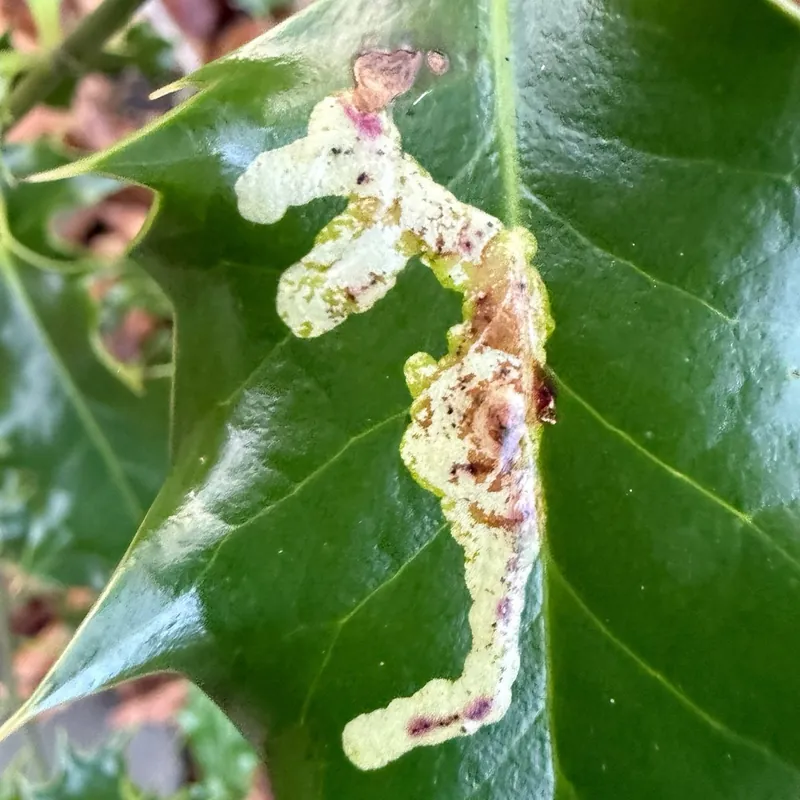
Short answer: Leaf miners are the larvae of small flies and moths that tunnel inside leaves. The giveaway is a pale, winding line or blotch in the leaf, often with a dark thread of droppings inside it. Pick off and throw away the worst mined leaves, and squash any larvae you can see inside the rest.
What it looks like
- Pale, winding trails that wander across the leaf
- Light tan or papery blotches that spread from one spot
- A thin dark line of droppings inside the trail or blotch
- A small pale larva you can see when you hold the leaf up to the light
- Blotched leaves of spinach, chard and beets that turn brown and dry out
- On citrus, winding mines in new leaves, with the leaf edge rolled over at the end
Is it leaf miners or something else?
| Could also be | How to tell |
|---|---|
| Leaf spot | Leaf spot makes brown or black spots, often with a yellow ring, on the leaf surface. A leaf miner's blotch or trail is hollow, and held up to the light you can see the larva or its droppings inside. |
| Thrips | Thrips leave silvery streaks on the surface, dotted with black specks. Mines are tunnels inside the leaf with clear edges, and the surface stays whole. |
| Mosaic virus | A virus mottles the whole leaf with light and dark patches and often twists it. Mines are separate pale trails or blotches with a clear start and end. |
Why it happens
Adult leaf miners are small flies or moths. They lay eggs on or in the leaves, and the larvae that hatch tunnel into the leaf and feed there, protected from weather, predators and most sprays. When they're grown, they leave to change into adults, many of them in the soil.
Spinach, beet and chard leaf miners make blotches and also live on weeds such as lambsquarters. Serpentine leaf miners make thin winding trails on beans, tomatoes, squash, lettuce and some flowers. The citrus leafminer is a tiny moth that mines only soft new leaves.
How to fix it
- Pick off and throw away the worst mined leaves. Remove leaves with large blotches or many trails and put them in the trash rather than the compost, so the larvae inside don't finish growing. This works best on leafy vegetables like spinach, chard and beets.
- Squash larvae inside the mines. On leaves with only a small mine, find the larva at the fresh end of the trail and pinch it between finger and thumb. The rest of the leaf keeps working for the plant.
- Cover crops like chard and beets with fine mesh. Lay fine insect mesh or row cover over young chard, beets and spinach in spring, before the adults start laying eggs, and tuck it in at the edges. Covers keep egg-laying adults out but won't help once larvae are already in the leaves.
- Leave healthy plants be. Established plants, citrus trees included, outgrow light damage. On citrus, leave mined leaves on the tree, since the undamaged parts still feed it. Tiny wasps that attack the larvae do much of the work, so skip broad-spectrum sprays that kill them.
Watch out: Sprays can't reach larvae inside the leaf. Removing mined leaves early does far more.
How to prevent it
- Put fine mesh or row cover over spinach, chard and beets before the adults become active in spring.
- Pull weeds such as lambsquarters near vegetable beds, since leaf miners breed on them too.
- Check young leaves of leafy crops often and pinch the first mines you see.
- Avoid broad-spectrum insecticides, which kill the tiny wasps that keep leaf miners in check.
Plants it often affects
- Spinach pale blotches that make the leaves hard to use
- Beet blotch mines on the leaves; the roots aren't affected
- Swiss chard large papery blotches on the leaves
- Lemon tree citrus leafminer trails on soft new leaves; older leaves are left alone
- Orange tree mined, curled new growth; mature trees tolerate it well
Questions people ask
Are leaf miners harmful to plants?
Usually not to established plants, which keep growing with a few mined leaves. They matter more on crops where you eat the leaves, like spinach and chard, and on very young plants. Mature citrus trees tolerate citrus leafminer with little effect on growth or fruit.
Can you eat leaves with leaf miner damage?
The mined patches are papery and hold the larva and its droppings, so cut them away and use the healthy parts of the leaf. On beets, the roots are fine to eat even if the leaves are mined.
Why don't sprays work on leaf miners?
The larvae feed inside the leaf, so most sprays never touch them. Picking off mined leaves, squashing the larvae and covering crops before the adults lay eggs work much better.

Not sure it's leaf miners?
Take a photo in Liana and the health check names the problem and tells you what to do first. Liana also reminds you to check the soil, so watering mistakes don't start. Get Liana for iPhone.
Sources
- University of Maryland Extension, Leafminers on Vegetables
- UC Statewide IPM Program, Citrus Leafminer