Leaf scorch on trees: why the leaf edges turn brown
Leaf scorch on trees and shrubs turns the edges and tips of the leaves brown, dry and crisp, and Japanese maples get it more than most. It happens when wind, hot sun, drought or damaged roots leave the leaves short of water. Leaf scorch isn't a disease, and it rarely does lasting harm, though the tree can look poor for the rest of the season.
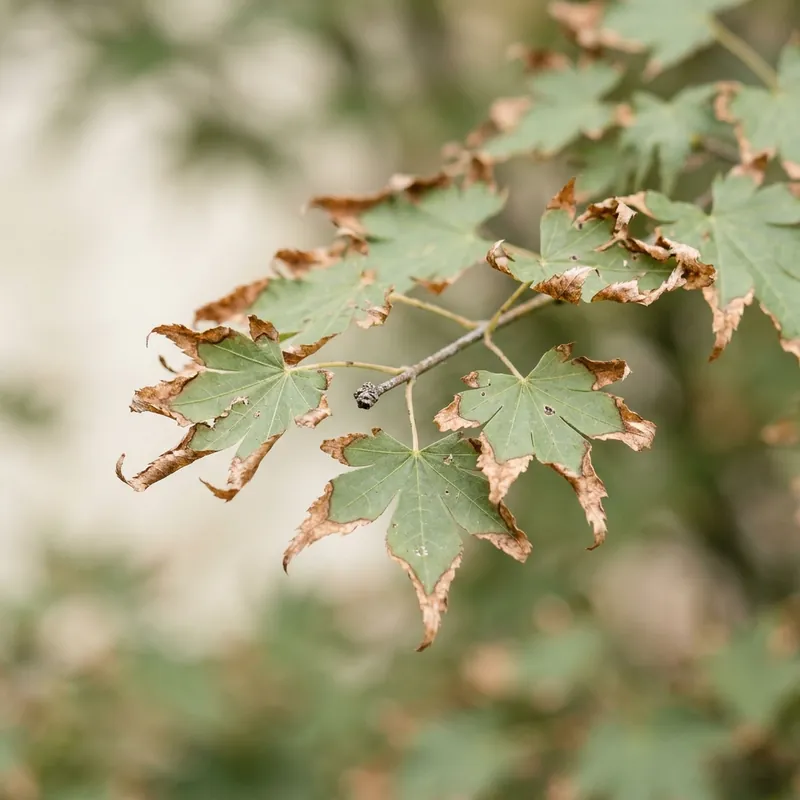
Short answer: Brown, crisp edges and tips on tree leaves in summer, often worst on the side facing the sun or wind, are leaf scorch. The leaves lose water faster than the roots can replace it. In dry spells, water deeply when the soil is dry, mulch over the root area, move potted maples out of hot sun and wind, and keep digging and traffic away from the roots.
What it looks like
- Brown, dry edges and tips on the leaves, with green tissue toward the middle
- Damage worst on the side of the tree facing the sun or the wind
- Leaves curling and shriveling, and in bad cases going crisp all over
- Scorch showing in hot, dry or windy weather, often in summer
- Fine-leaved Japanese maples affected more than other trees
- Badly scorched leaves dropping early
Is it leaf scorch or something else?
| Could also be | How to tell |
|---|---|
| Verticillium wilt | Verticillium wilt makes one branch or one side of a maple wilt and die, and the wood under the bark shows dark streaks. Scorch browns leaf edges across the exposed parts of the tree without killing whole branches. |
| Anthracnose | Anthracnose leaves brown blotches along the veins in cool, wet spring weather. Scorch follows heat, wind or drought and starts at the leaf edges. |
| Frost damage | A late spring frost browns and shrivels new maple leaves overnight. Scorch builds up over hot or dry spells later in the season. |
Why it happens
Leaves give off water all the time, and on hot, sunny or windy days they lose it fast. Scorch happens whenever water leaves the leaves faster than the roots can take it up. Drought, drying wind, strong sun and, in coastal gardens, salty wind are the usual triggers. The RHS notes that waterlogged soil can cause it too, because roots sitting in water can't work properly.
Damaged or cramped roots make any tree more likely to scorch. Trenching, new paving, soil piled over the roots, compaction from cars or foot traffic and recent planting all cut down how much water the roots can supply. Japanese maples have shallow, fine roots, and pots dry out quickly, which is why potted maples scorch so often.
How to fix it
- In dry spells, water deeply when the soil is dry. Check the soil under the canopy a few inches down. If it is dry, give a slow, deep soak over the whole root area, which reaches far beyond the trunk. Don't water soil that is already moist, since soggy roots scorch too.
- Mulch over the root area. Spread a layer of wood chips, shredded leaves or compost over the root zone to keep the soil cool and moist. Keep the mulch a few inches away from the trunk.
- Move potted maples out of hot sun and drying wind. Put containers where they get shade at midday and in the afternoon, and shelter from strong wind. A wall, fence or larger shrubs on the windy side helps.
- Keep digging, paving and heavy traffic away from the roots. Most of a tree's fine roots are near the surface and spread wide. Avoid trenching, parking or piling soil and materials under the canopy.
- Leave the scorched leaves on. Partly brown leaves still feed the tree and shade new growth. Picking them off is rarely practical, and they fall in autumn anyway.
Watch out: Scorched leaves won't turn green again, so the tree can look poor until autumn. Judge it by next spring's new leaves.
How to prevent it
- Plant Japanese maples in a sheltered spot out of strong midday sun and wind
- Choose soil that holds moisture but drains well
- Mulch young and newly planted trees every year
- Use large containers for maples and move them out of the hottest spots in summer
- Protect the root area from building work and parking
Plants it often affects
- Japanese maple the most often scorched, especially the fine, lace-leaved kinds
- Red maple leaf edges brown in hot, dry summers
- Sugar maple edges brown when roots are short of water in drought
- Norway maple scorches on dry sites, including some colored-leaf varieties
- Horse chestnut brown, dry leaf edges in hot, dry summers
Questions people ask
Will my Japanese maple recover from leaf scorch?
Usually, yes. Scorch rarely causes lasting harm, and the tree drops its leaves in autumn anyway. The scorched leaves won't turn green, so judge recovery by the new leaves next spring.
Is leaf scorch a disease?
No. Scorch comes from weather and root problems, and there is nothing to spray. Deep watering in dry spells, mulch, shelter and healthy roots are what help.
Should I fertilize a scorched tree?
No. Fertilizer pushes new growth the stressed roots can't support. Mulch and water deeply in dry spells instead, and feed only if a soil test shows a need.

Not sure it's leaf scorch?
Take a photo in Liana and the health check names the problem and tells you what to do first. Liana also reminds you to check the soil, so watering mistakes don't start. Get Liana for iPhone.
Sources
- Royal Horticultural Society, Acer: leaf scorch
- South Dakota State University Extension, Leaf Scorch and Sunscald in the Garden