Leafcutter bees: why your leaves have neat round holes
Leafcutter bees are solitary bees that cut neat semicircles from the edges of rose, lilac, redbud, wisteria and other leaves. They don't eat the pieces: they carry them off to line their nests. The damage is harmless, and the bees pollinate your flowers.
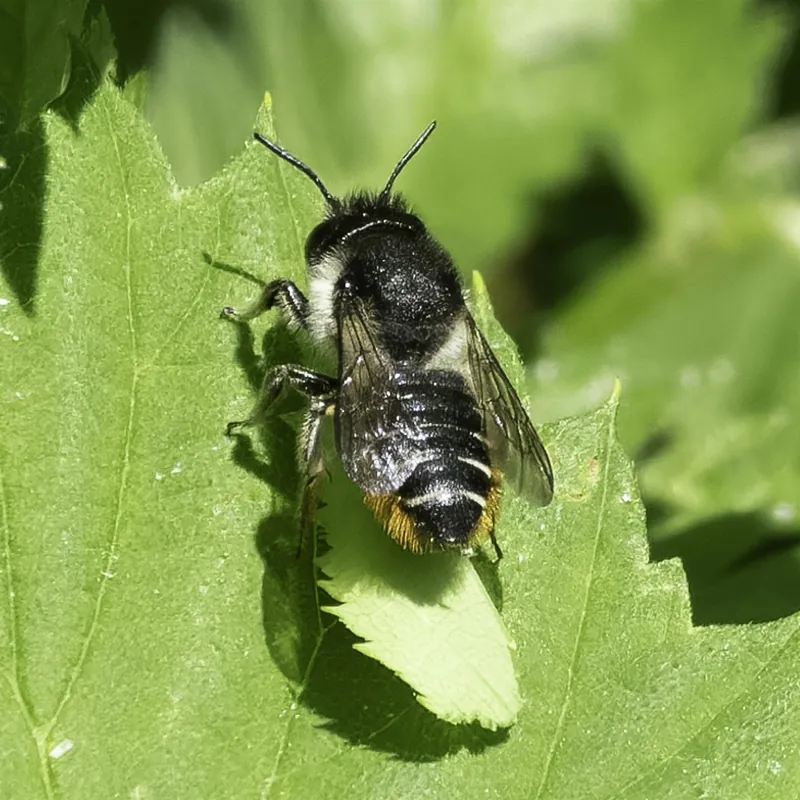
Short answer: Neat, smooth-edged semicircles about half an inch across, cut only from the edges of leaves, are the work of leafcutter bees. Each female bee uses the pieces to build cells for her young in hollow stems or wood. Leave them be: the plant loses only a little leaf and grows on normally.
What it looks like
- Smooth, neat semicircles or circles cut from the edges of leaves, about half an inch across or less
- Cuts only along the leaf edge, never holes in the middle
- No droppings, slime or insects feeding on the leaf
- Cut pieces missing entirely, not chewed or left lying around
- Small dark bees with pale bands flying off with a rolled piece of leaf
- Sometimes neat cuts in rose petals too
Is it leafcutter bees or something else?
| Could also be | How to tell |
|---|---|
| Black vine weevil | Vine weevil adults chew smaller, rougher notches around the leaf edge at night, and the plant may wilt from grubs eating the roots. Leafcutter bee cuts are larger, very smooth and round. |
| Caterpillars | Caterpillars chew ragged holes anywhere on the leaf and leave dark droppings. Leafcutter bees take clean semicircles from the edges only. |
| Japanese beetles | Japanese beetles eat the soft tissue between the veins, leaving lacy, skeletonized leaves, and you'll see the shiny green beetles on the plant. Leafcutter bees leave the rest of the leaf untouched. |
Why it happens
Female leafcutter bees nest alone in hollow stems, old beetle tunnels, holes in wood and pruned rose canes. Each one cuts pieces of leaf to build a row of cells, stocks each cell with pollen and nectar, lays an egg and seals it.
They feed on pollen and nectar, never on leaves. Roses, lilac, redbud and ash are among the plants whose leaves they use most.
Most species have one generation a year. The adults work in late spring and summer, and the young spend the winter in their leaf-lined cells.
How to fix it
- Leave them. The plant loses only a little leaf, and established plants carry on growing and flowering normally. The bees are valuable pollinators, so there's nothing to treat.
- Check the cuts are smooth, round and only along leaf edges. Look closely to be sure it's leafcutter bees. Smooth semicircles at the edge mean bees; ragged holes, holes in the middle of leaves or droppings point to caterpillars or beetles instead.
- Let them nest nearby. Leave some hollow stems standing in the garden or put up a bee hotel. More bees mean better pollination for your fruit and flowers.
- Protect a small, prized plant if you need to. If a young plant is losing a lot of leaf, drape it with cheesecloth or fine netting when the cutting starts. Take it off by midsummer, when the bees have finished nesting.
Watch out: Spraying won't stop them, since the bees never eat the leaves, and it harms pollinators. The damage is cosmetic and the plant carries on.
How to prevent it
- Accept a few cut leaves as the price of good pollination.
- Cover a young or show plant with fine netting in late spring if you'd rather keep it unmarked.
- Keep insecticides away from plants where the bees are cutting, since sprays harm the bees and do nothing for the leaves.
Plants it often affects
- Rose the classic host, with neat semicircles in leaves and sometimes petals
- Lilac round cuts along the leaf edges
- Redbud smooth heart-shaped leaves with circles taken from the margins
- Wisteria small leaflets with neat bites from the edges
Questions people ask
What is cutting perfect circles out of my rose leaves?
Smooth semicircles or circles cut from the edges of rose leaves are almost always leafcutter bees. They carry the pieces off to build their nests. The roses aren't harmed and will keep growing and flowering.
Should I get rid of leafcutter bees?
No. They're gentle solitary bees and useful pollinators, and the damage is cosmetic. Sprays don't stop the cutting, since the bees never eat the leaves, and they harm other helpful insects.
How long do leafcutter bees keep cutting leaves?
Only while the females are building nests, from late spring through early summer in most places. Once nesting is done, the cutting stops and the plant's new leaves grow in untouched.

Not sure it's leafcutter bees?
Take a photo in Liana and the health check names the problem and tells you what to do first. Liana also reminds you to check the soil, so watering mistakes don't start. Get Liana for iPhone.
Sources
- UC Statewide IPM Program, Leafcutting Bees
- Iowa State University Extension, Leafcutter Bees