Slime mold on mulch and lawns: strange looking, but harmless
Slime mold (slime mould, in Britain) shows up after warm rain as bright yellow foam on bark mulch or gray, crusty patches over grass blades. It looks alarming, but it feeds on bacteria and decaying matter and doesn't attack plants. It dries up and disappears on its own.
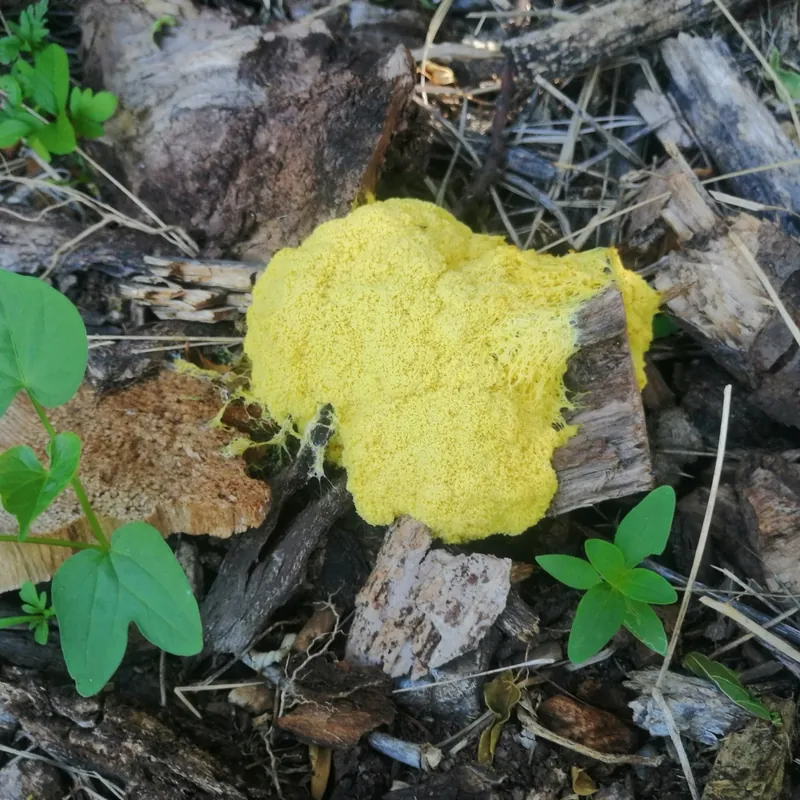
Short answer: Slime mold is a primitive organism that feeds on bacteria, fungi and decay in mulch, compost and lawns. It does not harm grass or plants, even when it spreads over them. Leave it to dry up, or rake it, hose it off or mow the lawn as usual if it bothers you.
What it looks like
- A bright yellow, orange or white foamy blob on bark mulch, from a few inches to more than a foot across
- Gray or dark beads and crusty patches coating grass blades
- Growth that appears suddenly, often overnight, after warm rain
- Patches that dry, turn brown and crumble into dark, dusty spores
- Grass and plants underneath that stay green
Is it slime mold or something else?
| Could also be | How to tell |
|---|---|
| Mold on the soil | Soil mold is a thin white fuzz or cobweb on potting mix. Slime mold is thicker, soft or foamy at first, often brightly colored, and turns to a powdery crust. |
| Rust | Rust on grass leaves orange or brown powder that rubs off on shoes, and the blades turn yellow. Slime mold sits on top of the blades and the grass underneath stays green. |
| Powdery mildew | Powdery mildew is a thin white dust growing on the leaves themselves and spreading over weeks. Slime mold forms a thicker crust and is gone within days. |
Why it happens
Slime molds are neither fungi nor plants. For most of their life they live unseen in moist mulch, leaf litter and soil, eating bacteria, fungi and decaying matter. After warm, wet weather they gather into a visible mass that can creep a short way across mulch before it turns into a crust of spores.
Organic mulch, compost and lawns hold the moisture and food they need, which is why they turn up in freshly mulched beds and on grass after summer rain. When the crust dries, its spores blow away, so the same spot often sees slime mold again in the next wet spell.
How to fix it
- Leave it alone. Slime mold dries up and goes away on its own, often within days of dry weather.
- Rake it up or hose it off if it bothers you. Scoop it up with the top of the mulch and add it to the compost, or break it up with a rake or a jet of water so it dries faster.
- Brush or mow lawn patches. On grass, brush the crust off the blades with a broom or rake, or simply mow as usual. The grass underneath will be fine.
- Turn bark mulch so it dries faster. Loosen thick mulch with a fork so air gets in and the surface dries. There is no need to dig it out or replace it.
Watch out: Its looks lead people to dig out mulch or treat the lawn. It goes away by itself within a week or two once the weather dries.
How to prevent it
- Keep mulch loose and about 2 to 4 inches deep
- Fluff up old mulch with a rake in fall so it dries between rains
- Accept it as part of healthy, living mulch; it is no reason to stop mulching
- Skip pesticides, which aren't needed and don't help
Plants it often affects
- Lawn grass gray or dark crusts on the blades after rain, gone within days and harmless
Questions people ask
Is slime mold harmful to plants or lawns?
No. It feeds on bacteria and decay, not on living plants, even when it looks like it is growing on them. The grass under a patch stays green and carries on growing once the slime mold dries.
What is the yellow foam on my mulch?
It is almost certainly a slime mold, often called dog vomit slime mold because of its looks. It appears after warm rain on bark mulch, then dries to a brown crust and releases its spores.
How do I get rid of slime mold?
Waiting for dry weather is enough. If you want it gone sooner, rake it, scoop it into the compost or rinse it off with a hose.

Not sure it's slime mold?
Take a photo in Liana and the health check names the problem and tells you what to do first. Liana also reminds you to check the soil, so watering mistakes don't start. Get Liana for iPhone.
Sources
- Oregon State University Extension Service, Slime mold blobs look scary in mulch but leave your plants alone
- Royal Horticultural Society, Slime moulds