Bottom leaves turning yellow: when it's normal
Bottom leaves turning yellow can look alarming, but very often it is a healthy plant letting go of its oldest leaves. Every leaf has a lifespan, and as a plant grows it pulls nutrients out of its lowest leaves and puts them into new ones. If the top of the plant looks good, there is usually nothing to fix.
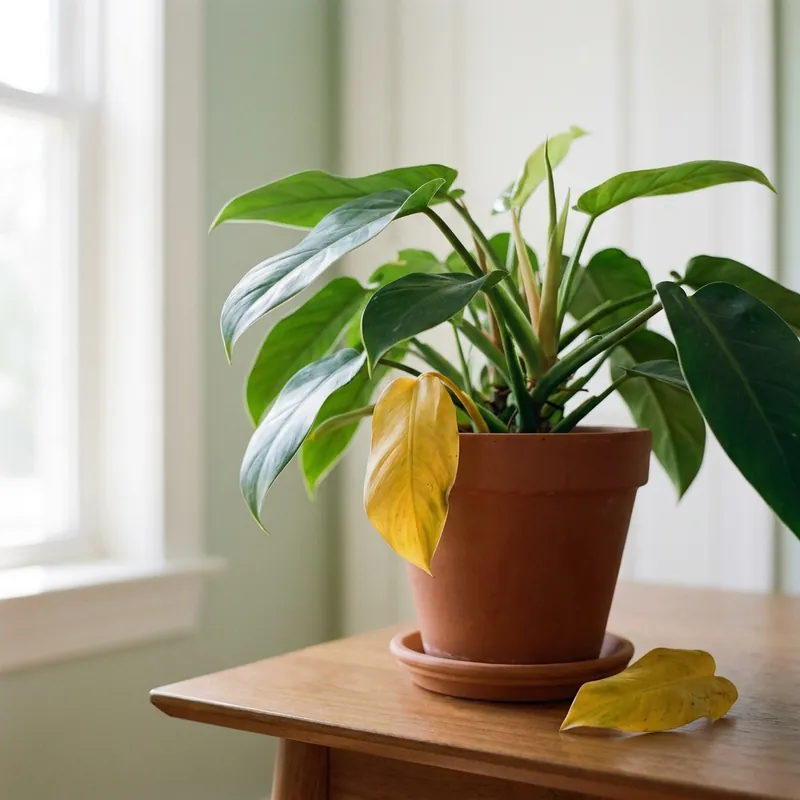
Short answer: If only one or two of the oldest, lowest leaves turn yellow and drop while new growth looks healthy, it is natural leaf drop. The plant is moving resources from old leaves to new ones. Leave the leaf until it comes away easily, then remove it, and don't change your care.
What it looks like
- One or two of the oldest, lowest leaves turning evenly yellow
- Leaves yellowing slowly, one at a time, over weeks
- Healthy new leaves at the top, with good color and normal size
- The yellow leaf comes away with a gentle tug once it is fully yellow or brown
- Soil that is neither soggy nor bone dry
- On bulbs such as grape hyacinth, leaves yellowing after flowering
Is it natural leaf drop or something else?
| Could also be | How to tell |
|---|---|
| Overwatering | Overwatering yellows several lower leaves at once, often limp or soft, and the soil stays wet. Natural drop is one old leaf at a time on a plant whose soil dries normally. |
| Nutrient deficiency | A hungry plant yellows several older leaves and slows down overall. With natural drop the rest of the plant stays deep green and keeps growing. |
| Not enough light | Low light also costs a plant its lower leaves, but it brings stretched stems and smaller new leaves too. With natural drop, new leaves arrive at full size. |
Why it happens
Leaves wear out. As a plant matures, its oldest leaves at the bottom are shaded by newer ones and do less work. The plant draws back the useful nutrients and lets them go, which is why they turn yellow before they fall.
Some plants shed old growth as part of their normal cycle. Spring bulbs let their leaves yellow after flowering as they rest, a bromeliad's main rosette slowly fades after it blooms while young offsets grow, and elephant ears often lose an old leaf as a new one opens.
How to fix it
- Leave it until it comes away easily. A yellowing leaf is still giving nutrients back to the plant. Once it is fully yellow or brown and lifts off with a light tug, remove it, or snip it close to the stem with clean scissors.
- Check that new growth looks healthy. New leaves are the real signal. If they are a good color, a normal size and keep coming, the plant is fine.
- Resist the urge to change anything. Extra water, fertilizer or a new pot can cause the very problems you are worried about. Keep checking the soil and watering only when it is dry, as before.
- Look closer if it speeds up. If several leaves yellow at once, or the yellow reaches new leaves at the top, it is no longer normal ageing. Check the soil moisture first, then light and roots.
Watch out: Most worry that a plant is dying turns out to be this. If the new leaves look fine, the plant is fine.
How to prevent it
- Expect the odd lower leaf to yellow on any growing plant, especially large ones
- Judge a plant's health by its newest leaves, not its oldest
- Keep care steady and check the soil before watering
- Let bulb foliage die back on its own after flowering
Plants it often affects
- Wandering dude older leaves at the base of the stems dry up, leaving bare stems
- Guzmania the flowering rosette fades slowly after blooming while pups grow
- Venus flytrap old traps turn black and die back as new ones form
- Grape hyacinth leaves yellow and wither after flowering as the bulb rests
- Elephant ear (alocasia) often drops its oldest leaf as a new one unfurls
Questions people ask
Should I cut off yellow leaves?
You can, once they are fully yellow or come away easily. Until then the plant is still pulling nutrients out of them. Cutting one off sooner won't hurt the plant much.
How many yellow leaves are normal?
One or two of the oldest leaves at a time, yellowing slowly, is normal for most plants. Several yellowing together, or yellow on the newest leaves, means something in its care needs a look.
Do yellow leaves mean I'm overwatering?
Only if other signs agree: soil that stays wet, several soft or limp yellow leaves, or a sour smell. A single old leaf on a plant with healthy new growth is usually just age.

Not sure it's natural leaf drop?
Take a photo in Liana and the health check names the problem and tells you what to do first. Liana also reminds you to check the soil, so watering mistakes don't start. Get Liana for iPhone.
Sources
- Royal Horticultural Society, Leaf damage on houseplants
- University of Maryland Extension (Ask Extension), Corn plant (Dracaena fragrans) leaves are turning yellow and falling off