Psyllids: curled bay leaves, cupped boxwood and sticky pears
Psyllids are small sap-sucking insects, also called jumping plant lice, and known in Britain as suckers. Bay psyllid curls and thickens bay leaf edges, boxwood psyllid cups the shoot tips, and pear psylla leaves trees sticky with honeydew. The damage usually looks worse than it is.
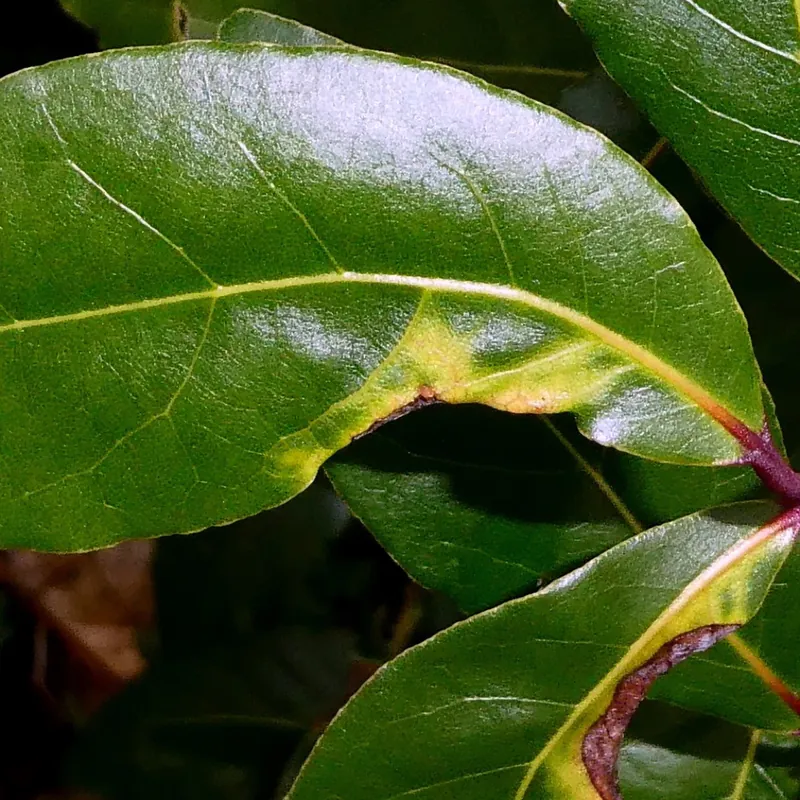
Short answer: Psyllids are tiny, aphid-like insects that jump when disturbed, while their flat young sit under curled leaves in white, waxy fluff. On bay, look for thick, yellowing leaf edges curled downward; on boxwood, cupped, cabbage-like shoot tips. Snip off the worst leaves or tips and leave the rest to ladybugs and other predators.
What it looks like
- Bay leaf edges that thicken, curl downward and turn yellow, later drying brown
- Boxwood shoot tips with cupped, cabbage-like leaves in spring
- White, waxy threads or fluff on new growth, sometimes dripping
- Flat, pale young insects tucked under curled leaf margins
- Sticky honeydew on leaves and fruit, sometimes with black sooty mold
- Small adults that jump or fly off when you brush the plant
Is it psyllids or something else?
| Could also be | How to tell |
|---|---|
| Aphids | Aphids are pear-shaped and cluster openly on shoot tips, and most don't jump. Psyllid adults hop off when disturbed, and their young hide in curled leaves under white wax. |
| Mealybugs | Mealybugs are oval insects coated in white wax that crawl slowly in leaf joints. Psyllid young are flatter and sit inside curled bay leaves or cupped boxwood tips, with wax threads around them. |
| Scale | Scale insects are fixed bumps on stems and along leaf veins, and they don't curl the leaves. Bay often gets both, so look for curled edges as well as bumps. |
Why it happens
Psyllids feed on soft new growth in spring and summer. On bay and boxwood their feeding makes the young leaves thicken, curl or cup around them, which gives the young insects shelter.
Each kind of psyllid sticks to its own host: bay psyllid on bay laurel, boxwood psyllid on boxwood, pear psylla on pears. Others live on citrus, tomatoes and potatoes, and a few, such as Asian citrus psyllid, spread plant diseases.
Lots of soft new growth suits them, so heavy nitrogen feeding and frequent shearing can mean more psyllids. Ants that collect their honeydew may guard them from predators.
How to fix it
- Pick off curled bay leaves. Remove the worst curled, thickened leaves and put them in the trash rather than the compost pile. You don't need to strip every damaged leaf, since the plant's growth is usually unaffected.
- Clip boxwood in late spring. A normal trim in late spring removes many of the young psyllids along with the cupped tips. Hedges and topiary that get clipped anyway rarely need anything more.
- Let ladybugs deal with pear psylla. On pear trees, ladybugs, lacewing larvae, predatory bugs and tiny parasitic wasps all feed on psylla. Leave them to work and avoid broad-spectrum sprays that would kill them.
- Wash off honeydew. Rinse sticky leaves and fruit with plain water so sooty mold can't take hold. A hose works outdoors; wipe small potted bays with a damp cloth.
- Go easy on fertilizer. Avoid heavy nitrogen feeding on established shrubs and trees. It pushes out the soft new growth that psyllids feed on.
Watch out: Bay and boxwood damage looks worse than it is. Snipping off affected leaves and tips is enough; spraying also kills the ladybugs that help.
How to prevent it
- Check bay and boxwood shoot tips in spring, when psyllids are most active.
- Feed established shrubs lightly, without heavy nitrogen.
- Keep broad-spectrum insecticides out of the garden so ladybugs and other predators stay.
- Keep ants off affected plants, since they protect psyllids from predators.
Plants it often affects
- Bay laurel leaf edges thicken, curl down and yellow, often on half the leaf
- Boxwood cupped, cabbage-like shoot tips with white wax in spring
- Pear honeydew and sooty mold on leaves and fruit
- Citrus Asian citrus psyllid can spread a serious citrus disease
- Tomato potato psyllid feeds on tomatoes too and can spread disease
Questions people ask
Why are my bay leaves curling and turning yellow at the edges?
Thick, curled-under edges that yellow and later turn brown are the classic sign of bay psyllid. Unroll one and you'll often find small gray-white young in fluffy wax. Pick off the worst leaves; the tree usually carries on growing normally.
Do psyllids kill boxwood?
No. Boxwood psyllid only cups the spring shoot tips and leaves white wax behind. A normal clip removes most of the damage, and no further damage happens after early summer.
Should I spray for psyllids?
Usually not. Most psyllids on garden shrubs need no control, and sprays also kill the ladybugs and other predators that keep them down. Snipping off damaged tips and washing off honeydew is enough in most gardens.

Not sure it's psyllids?
Take a photo in Liana and the health check names the problem and tells you what to do first. Liana also reminds you to check the soil, so watering mistakes don't start. Get Liana for iPhone.
Sources
- UC Statewide IPM Program, Psyllids
- Royal Horticultural Society, Bay sucker