Red lily leaf beetle: how to spot and control it
The red lily leaf beetle (known as the lily beetle or scarlet lily beetle in Britain) is a bright red beetle that feeds on true lilies and fritillaries. Its orange larvae hide under a coat of their own black droppings, and together they can strip a plant of leaves and buds in a short time. Regular hand-picking keeps them under control.
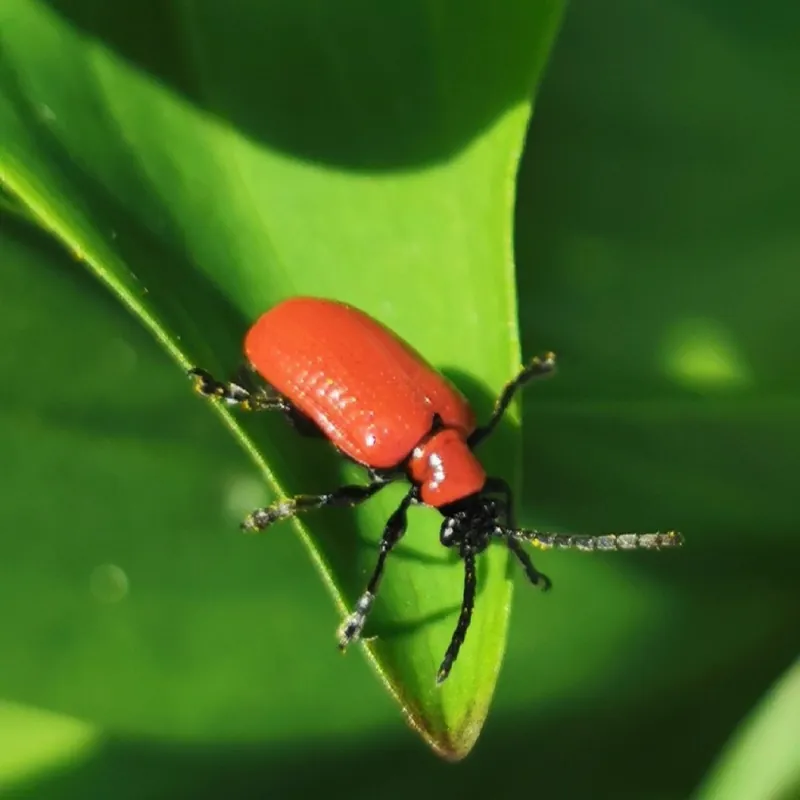
Short answer: Red lily leaf beetles are bright scarlet beetles about 1/4 inch long, with black heads, legs and undersides. Look for the red adults on lily leaves and for slimy brown blobs on the leaf undersides, which are larvae covered in droppings. Pick off and squash the adults today, holding a hand underneath, because they drop when disturbed.
What it looks like
- Bright scarlet beetles on the leaves, stems and buds of lilies
- Wet, dark blobs that look like bird droppings on the undersides of leaves (larvae under their droppings)
- Leaves eaten from the tips toward the stem, sometimes down to bare stalks
- Irregular holes and notches in leaves, buds and petals
- Rows of small orange-red eggs along the veins under the leaves
- Beetles that fall to the ground and vanish as you reach for them
Is it red lily leaf beetle or something else?
| Could also be | How to tell |
|---|---|
| Lady beetles | Lady beetles are round and usually spotted, and they're welcome because they eat other pests. Lily leaf beetles are longer, plain scarlet with no spots, and are found on lilies and fritillaries. |
| Slugs and snails | Slugs also chew lily leaves, but they leave silvery slime trails and feed mostly at night. Lily leaf beetles and their dark larvae are easy to find on the plant by day. |
| Gray mold | Gray mold (botrytis) makes brown spots and fuzzy gray growth on lily leaves and buds, but no holes. Beetle damage is chewed, with the insects or their droppings nearby. |
Why it happens
Adults spend the winter in the soil, leaf litter and other sheltered spots, often away from your lilies. They come out early in spring, find lilies by scent, then feed, mate and lay eggs on the leaf undersides.
The eggs hatch within about a week. The larvae feed for two to three weeks and cause most of the damage, then drop into the soil to pupate. A new set of adults comes out later in summer and keeps feeding into autumn. There is one generation a year.
The beetle only breeds on true lilies and fritillaries. Daylilies, canna lilies and calla lilies aren't affected.
How to fix it
- Pick off the red adults and squash them today. Look over every lily and fritillary and pick off each red beetle you see. Squash them, or drop them into a cup of soapy water. Gloves help if you'd rather not touch them.
- Hold a hand or a sheet underneath. Disturbed beetles drop off the plant, land on their backs with the black side up and disappear against the soil. Cup a hand or hold a light-colored cloth below the beetle before you reach for it.
- Wipe the larvae off the leaf undersides. Turn the leaves over and wipe or scrape off the slimy dark blobs, which are larvae under their droppings. Wear gloves or use a damp paper towel. Crush any rows of orange-red eggs you find at the same time.
- Check every few days until the leaves die back. Adults keep arriving and laying eggs from spring into summer, and a new batch appears later in the season. Look over your lilies every few days until the foliage dies back in autumn.
Watch out: Disturbed beetles fall on their backs, black side up, and vanish into the soil. Hold something underneath before you reach in.
How to prevent it
- Start checking lilies and fritillaries as soon as their shoots come up in spring, before the first eggs are laid.
- Look under the leaves for eggs and larvae each time you check, not only for the red adults.
- If the beetle is a constant problem, try lilies reported to be more tolerant, or replace some with plants it doesn't attack, such as daylilies.
- Let birds, frogs, ground beetles and lady beetles help by avoiding broad-spectrum sprays.
Plants it often affects
- Garden lily hybrid lilies in beds and pots, eaten from leaf tips to buds
- Tiger lily leaves stripped from the tips down
- Madonna lily adults and larvae on leaves and buds
- Martagon lily larvae hide under the whorled leaves
- Crown imperial a fritillary, so the beetles breed on it too
- Snake's head fritillary small plants can be stripped quickly
Questions people ask
Do red lily leaf beetles eat daylilies?
No. Daylilies aren't true lilies, and the beetle doesn't damage them. Canna lilies and calla lilies are safe too. The beetle breeds only on true lilies and fritillaries.
What are the brown slimy blobs on my lily leaves?
They're almost certainly lily leaf beetle larvae, which cover themselves in their own wet droppings. Underneath is a plump orange or yellowish larva with a black head. Wipe them off with a gloved hand or a damp paper towel.
Will my lilies come back after lily beetle damage?
Usually, yes, since the bulb is underground. A plant stripped bare early in the season may make a smaller bulb and flower less the next year, so it's worth stopping the beetles early.

Not sure it's red lily leaf beetle?
Take a photo in Liana and the health check names the problem and tells you what to do first. Liana also reminds you to check the soil, so watering mistakes don't start. Get Liana for iPhone.
Sources
- University of Wisconsin-Madison Extension, Lily Leaf Beetle
- Royal Horticultural Society, Lily beetle