Variegated plant reverting to green: how to stop it taking over
A variegated plant reverting to green sends up shoots with plain green leaves among its striped, splashed or edged ones. It happens on euonymus, elaeagnus, maples, ficus and pothos, among many others. Green leaves grow faster than variegated ones, so if you leave those shoots, they slowly take over the plant.
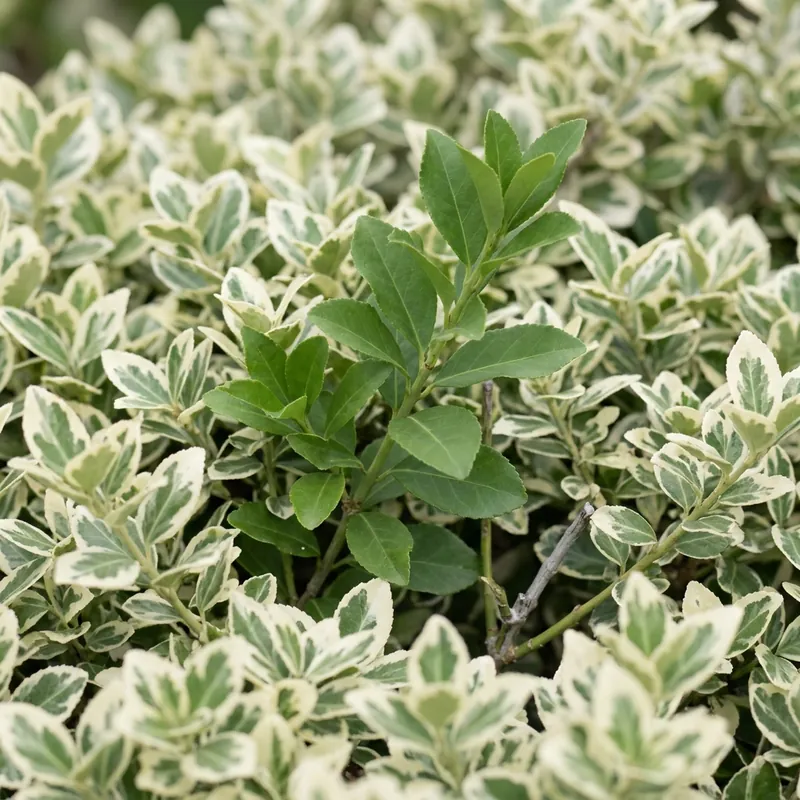
Short answer: Plain green shoots on a variegated plant are reversion, a return to the plant's original form. Cut each all-green shoot out today, right back to where it starts, and cut into variegated growth if needed so no green bud is left. Check again each spring and summer, and give variegated houseplants bright light.
What it looks like
- Shoots or stems carrying only plain green leaves on a variegated plant
- Green shoots growing longer and stronger than the variegated ones around them
- A patch of the plant gradually turning all green
- New leaves with less and less variegation on a houseplant in a dim room
- Green shoots appearing in spring or summer, often after a change in temperature
Is it reverted variegation or something else?
| Could also be | How to tell |
|---|---|
| Too little light | In a dim room, a variegated houseplant's new leaves come in greener all over, with weaker markings, and the stems stretch. True reversion is a shoot of fully plain leaves, while the rest of the plant stays variegated. |
| Mosaic virus | Mosaic virus makes a blotchy pattern of light and dark green with distorted new leaves. Variegation is a stable, regular pattern, and reverted shoots are simply plain green. |
| All-white shoots | Some variegated plants, such as hollies, throw shoots with all-white or pale yellow leaves. These are weak and rarely take over, though you can cut them out for looks. |
Why it happens
Most variegated plants started as a mutation on a green plant, kept going by cuttings, grafting or division. The mutation isn't always stable, so now and then a bud produces leaves like the original green parent. The RHS notes that reversion usually shows up in spring or summer, often in response to swings in temperature.
Green leaves hold more chlorophyll than variegated ones, so they make more food and grow faster. A single reverted shoot can outgrow the rest of the plant within a few seasons. In houseplants, low light pushes the same way, because greener leaves help the plant make the most of dim light.
How to fix it
- Cut all-green shoots out today. Follow each plain green shoot back to where it grows from the main stem or branch, and cut it off there with clean pruners or scissors. The sooner you do it, the smaller the cut.
- Cut into variegated growth if needed. If the green shoot starts partway along a variegated stem, cut back into the variegated part so that no green bud is left behind. A small leftover bud will sprout plain green again.
- Check again each spring and summer. Look over variegated shrubs and houseplants every few weeks during the growing season. Catching a green shoot early is much easier than taking out a big branch.
- Give variegated houseplants bright light. Pothos, ficus and other variegated houseplants keep their markings best in bright, indirect light. In a dim room, new leaves come in greener.
- Take cuttings only from variegated growth. If you propagate the plant, choose well-marked stems. Cuttings from green shoots grow into plain green plants.
Watch out: Trimming only the tip of a green shoot leaves buds that sprout plain green again. Cut it out at the base.
How to prevent it
- Inspect variegated shrubs in spring and summer, when reversion usually starts
- Cut out green shoots while they are still small
- Keep variegated houseplants in bright, indirect light
- Look inside dense shrubs too, where green shoots can hide among variegated branches
Plants it often affects
- Golden pothos new leaves turn plain green, especially in low light
- Wintercreeper euonymus variegated forms often throw strong, all-green shoots
- Japanese euonymus plain green branches appear among the gold or white-edged leaves
- Elaeagnus variegated kinds are prone to vigorous green shoots
- New Zealand flax colored forms can revert to plain green leaves
Questions people ask
Can a reverted plant become variegated again?
A green shoot won't turn variegated again. The rest of the plant keeps its markings, so cut out the green shoots and the variegated growth will fill the gap.
Why is my variegated pothos turning green?
Most often the light is too low, and the plant makes greener leaves to catch more of it. Move it to bright, indirect light, cut back the plainest stems, and new leaves should carry more variegation.
When is the best time to cut out reverted shoots?
As soon as you see them, at any time of year. Green shoots grow fast, so waiting only makes the cut bigger.

Not sure it's reverted variegation?
Take a photo in Liana and the health check names the problem and tells you what to do first. Liana also reminds you to check the soil, so watering mistakes don't start. Get Liana for iPhone.
Sources
- Royal Horticultural Society, Reversion