Tar spot on maple leaves: what it is and why your tree is fine
Tar spot on maple leaves shows up as raised, shiny black spots that look like drops of tar, often with a yellow ring around them. It is caused by a fungus and is most noticeable on Norway, silver and sycamore maples. It looks alarming, but it does the tree no lasting harm.
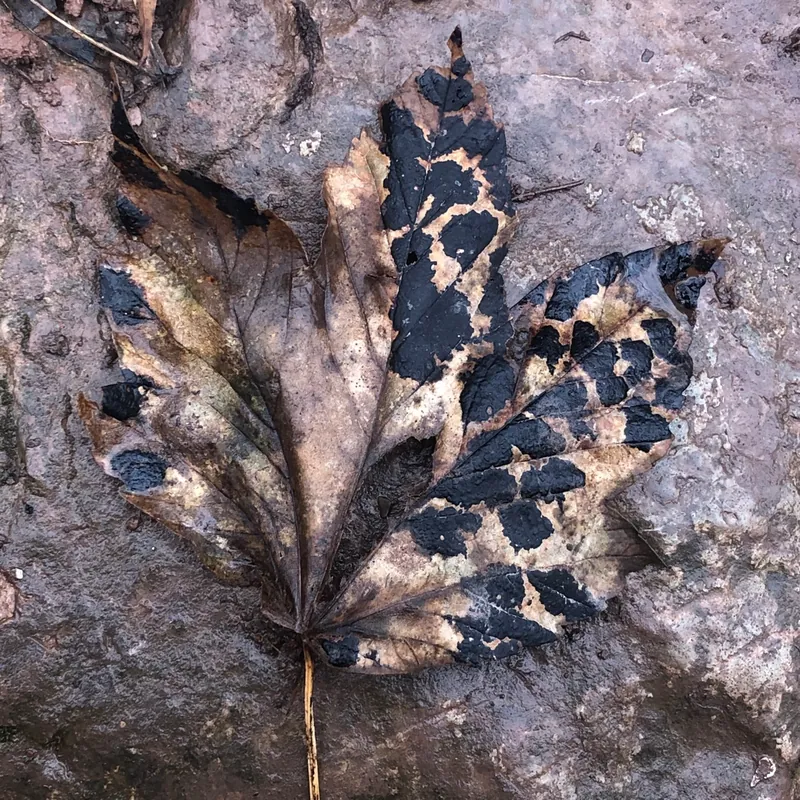
Short answer: Tar spot is a fungal leaf spot of maples. The giveaway is glossy black, tar-like spots on the upper side of the leaves by late summer, usually ringed with yellow. The tree needs no treatment: rake up and throw away the fallen leaves in fall to cut down next year's spots.
What it looks like
- Raised, shiny black spots on the upper side of maple leaves, like drops of tar
- A yellow or pale green ring around each spot
- Small pale yellow spots in early summer that darken and grow over the season
- Many small black dots clustered together on Norway maple, or single larger spots on silver maple
- Spots that are easiest to see from late summer into fall
- Sometimes slightly early leaf drop in a heavy year, with the tree otherwise healthy
Is it tar spot or something else?
| Could also be | How to tell |
|---|---|
| Anthracnose | Anthracnose makes brown or purplish blotches along the veins in cool, wet springs, and leaves may drop early in the season. Tar spot is jet black, raised and shiny, and appears later in summer. |
| Leaf scorch | Scorch browns the leaf edges and the tissue between the veins after heat, wind or drought. It makes no round, raised black spots. |
Why it happens
Tar spot is caused by fungi that spend the winter in fallen, infected leaves. In spring they release spores that wind and rain carry onto the new leaves. The spots then develop slowly and turn black by mid to late summer.
Some years look much worse than others. Because the spores also blow in from other maples nearby, you will often see a few spots every year even if you clean up well.
The disease is mostly cosmetic. It does not kill trees and rarely causes serious leaf loss, and any early drop happens so late in the season that the tree is barely affected.
How to fix it
- Leave the tree be. No pruning or spraying is needed. The spotted leaves keep working and fall as usual in fall.
- Rake up fallen leaves in fall and throw them away. Collect the leaves as they drop and put them in the trash, or bury them. A cold compost pile won't get hot enough to kill the fungus.
- Expect a few spots again next year. Spores blow in from neighboring maples, so a few spots are normal even after a good cleanup. Raking each year keeps the numbers down.
Watch out: Spotted leaves don't mean a dying tree. If the tree wilts or loses whole branches, look for another cause.
How to prevent it
- Rake and remove maple leaves every fall
- Don't leave infected leaves as mulch under the tree
- Keep the tree growing well with deep watering in long dry spells
- Accept a few spots in wet years, since spores blow in from nearby trees
Plants it often affects
- Norway maple the most striking spots, often merging into large black patches
- Silver maple single, larger raised spots with wavy lines on them
- Sugar maple commonly spotted in late summer
- Sycamore maple the European maple where tar spot is best known
- Boxelder a maple relative that gets the same black spots
Questions people ask
Will tar spot kill my maple tree?
No. Tar spot is a cosmetic leaf disease. It does not kill trees and rarely causes much leaf loss. If a maple is wilting or losing whole branches, the cause is something else.
Should I spray my maple for tar spot?
Spraying is rarely worth it for a garden tree. A large canopy is hard to cover, and spores from neighboring maples reinfect it anyway. Raking up the fallen leaves each fall is the practical fix.
Can I compost maple leaves with tar spot?
Only in a hot compost pile that you turn so the outer leaves end up in the hot center. A cool backyard pile lets the fungus survive, so trash or burying is safer.

Not sure it's tar spot?
Take a photo in Liana and the health check names the problem and tells you what to do first. Liana also reminds you to check the soil, so watering mistakes don't start. Get Liana for iPhone.
Sources
- University of Wisconsin-Madison Extension, Tar Spot of Trees and Shrubs
- UConn Home & Garden Education Center, Tar Spot of Maple