Plant leaves turning yellow? Read where the yellow is
Plant leaves turning yellow can mean several different things, and the leaf itself looks much the same in each case. The clue is where the yellow shows up. Old leaves or new ones, the whole leaf or patches, the side facing the window or the inside of the plant: each pattern points to a different cause.
Short answer: in most homes, yellow leaves come from water. Too much is more common than too little. Feel the soil first. If it is still wet days after watering and the lower leaves are soft and yellow, the roots are sitting in water. If it is bone dry and the leaves are crisp, the plant is thirsty. If the soil seems fine, look at light, pests and feeding, in that order.
Match the pattern
Find the row that looks most like your plant, then start your checks there.
| Where the yellow is | What else you notice | Most likely cause |
|---|---|---|
| One or two of the oldest, lowest leaves | The rest of the plant looks healthy and keeps growing | Normal aging |
| Lower and inner leaves, several at once | Leaves feel soft, soil is still damp days after watering, maybe a sour smell | Overwatering or root rot |
| Leaves anywhere, turning yellow then brown and crisp | Soil is dry and has shrunk away from the pot | Underwatering |
| Pale yellow-green all over | Long, thin stems leaning toward the window, small new leaves | Too little light |
| Bleached or yellow patches on the side facing the window | Patches turn brown and papery | Sunburn |
| Older leaves evenly pale | Not fed for a long time, or the same potting mix for years | Hungry plant |
| New leaves yellow, with the veins still green | Old leaves look fine | The plant can't take up iron, often from old, tired mix |
| Fine yellow speckles or blotches | Webbing, cottony tufts, bumps or sticky leaves | Pests |
| Many leaves at once, a few days after a change | Recent move, repotting, a cold window or a heater blowing on it | Shock or cold |
What to check first
Go through these in order. Most cases are solved by the first two.
- Feel the soil. Push a finger in an inch or two. Wet days after watering, or bone dry and pulling away from the pot? Water is your answer. If you can't tell, lift the pot: a dry pot feels surprisingly light.
- Check the pot. Does it have a drainage hole, and is water standing in the saucer or the decorative outer pot? A pot without a hole is the most common reason a careful owner still overwaters.
- Turn the leaves over. Look at the undersides and where leaves meet stems. Spider mites, mealybugs and scale hide there.
- Think about light. Has the plant moved, or did the season change? A spot that was bright in summer can be dim in winter.
- Think about food and soil. When was it last repotted or fed?
- Look at the roots if you still don't know. Ease the plant out of its pot. Healthy roots are firm and pale. Brown, mushy roots that smell bad mean root rot.
The 8 causes and how to fix each
1. Overwatering and root rot
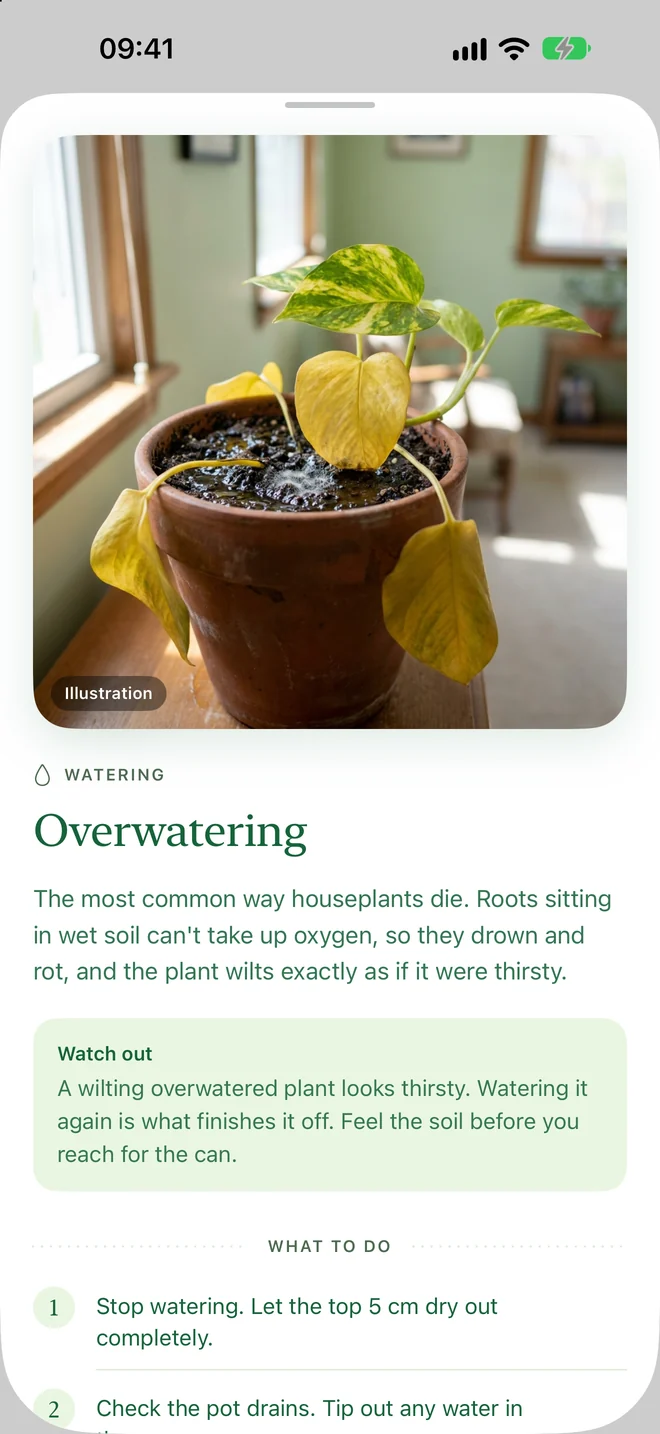
This is the most common cause. Roots need air as well as water. In soil that stays wet, the fine roots die, and a plant with dying roots can't drink, even standing in water. That is why an overwatered plant can wilt like a thirsty one. Yellowing usually starts on the lower and inner leaves, and the leaves feel soft rather than crisp.
Fix: stop watering and let the top of the soil dry out. Empty any saucer. If the soil smells sour or the plant keeps declining, check the roots, cut away anything brown and mushy, and repot into fresh mix in a pot with a drainage hole. From then on, water only when the soil tells you to. Our guide to overwatered vs underwatered plants goes through the rescue step by step.
2. Underwatering
A plant left dry too long gives up its older leaves first so it can keep the new ones. They turn yellow, then brown and crisp, often from the edges in. The soil is hard and dry and may have pulled away from the sides of the pot.
Fix: water slowly until it runs out of the bottom. If the soil has shrunk away from the pot, water runs straight down the gap, so stand the pot in a bowl of water for 20 to 30 minutes and let it soak up from below. Then let it drain. The yellow leaves won't recover, but new growth should be green.
3. Too little light
A plant in a dim spot makes less food than it needs and pulls it from older leaves. You see pale yellow-green leaves all over, long stretched stems and smaller new leaves leaning toward the window. It often starts in fall and winter, when the same window gives much less light.
Fix: move it closer to a window, ideally within a few feet, without hot midday sun hitting it through the glass. Wipe dusty leaves. Water less while it is in low light, since it uses water more slowly.
4. Sunburn
Too much direct sun, especially after a move from a dim spot, bleaches leaves. You get pale yellow or white patches on the leaves facing the light, which later turn brown and papery.
Fix: pull the plant back from the glass or filter the light with a sheer curtain. If you are moving a plant into a sunnier spot, do it gradually over a couple of weeks. Burned patches stay, so trim the worst leaves once new ones grow.
5. A hungry plant
Potting mix runs out of nutrients after a year or two. Nitrogen moves inside the plant, so when it runs short, the plant takes it from older leaves and they turn evenly pale. Iron behaves the other way: when a plant can't get enough, the youngest leaves turn yellow while their veins stay green. In houseplants that usually means old, compacted mix rather than a real lack of iron.
Fix: feed with a balanced houseplant fertilizer during the growing season, at the strength on the label or weaker, and never on dry soil. If the plant has been in the same mix for more than two years, repot in spring with fresh mix. Don't feed a plant that is yellowing from overwatering. It can't use the food, and the salts add to the damage.
6. Pests
Sap-sucking pests leave yellow behind them. Spider mites cause fine yellow speckling and, later, thin webbing. Mealybugs look like small tufts of cotton in leaf joints. Scale looks like brown bumps stuck to stems and leaf veins. Aphids and scale leave sticky leaves.
Fix: isolate the plant so the pests don't spread. Rinse the leaves in the shower, top and bottom. Wipe off mealybugs and scale with a cotton swab dipped in rubbing alcohol. Repeat every few days for a couple of weeks, because eggs hatch after the first round. Spider mites like dry air, so a dry, warm room makes them worse.
7. Shock and cold
Plants dislike sudden change. A move from the store, repotting, a cold draft from a door or window, or a heater blowing on them can make several leaves yellow and drop within days. Tropical houseplants also suffer when leaves touch a cold window in winter.
Fix: keep the plant away from drafts, heaters and cold glass, and then leave it alone. Don't repot, feed or move it again while it settles. After repotting, a couple of yellow leaves are normal.
8. Normal aging
Leaves don't live forever. Many plants, pothos and philodendrons especially, shed their oldest leaves from time to time. If it is one leaf at a time, low on the plant, and the plant keeps putting out healthy new growth, nothing is wrong.
Fix: none needed. Pull the leaf off once it is fully yellow and comes away easily.
Plants that yellow in their own way
- Pothos and philodendron: a yellow leaf now and then is aging. Several at once almost always means too much water.
- Peace lily: it droops dramatically when dry and recovers within hours of a drink. If you wait for the droop every time, the older leaves yellow. Water when the top inch is dry instead.
- Snake plant and ZZ plant: they store water in their leaves and roots. Yellow leaves that feel soft at the base mean rot from watering too often. Let the soil dry right through between drinks.
- Monstera and fiddle-leaf fig: yellowing with brown patches usually follows wet soil in a pot that is too big, or a move to a darker spot.
- Calathea and prayer plant: crisp yellow and brown edges more often mean dry air than wrong watering.
Questions people ask
Can yellow leaves turn green again?
Usually not. A leaf that is fully yellow has broken down the green pigment it needs and won't make it again. A leaf that is only slightly pale can recover once the cause is fixed, for example after a plant gets more light or is fed.
Should I cut off yellow leaves?
Yes, once a leaf is mostly yellow. It no longer helps the plant, and removing it lets you see whether new yellowing appears. Pull it gently or cut it at the stem with clean scissors. Leave half-green leaves for now; they still feed the plant.
Is it overwatering or underwatering?
The soil tells you. Damp soil with soft yellow leaves points to overwatering; dry soil with crisp yellow leaves points to underwatering. Our side-by-side guide covers the trickier cases.
How often should I water to avoid yellow leaves?
There is no safe fixed schedule, because a plant drinks less in winter, in low light and in a large pot. Check the soil and water when it is dry to the right depth for that plant. Our watering chart for 20 houseplants gives typical ranges.

Not sure what's wrong?
Take a photo in Liana and the health check names the problem and tells you what to do. Liana also reminds you to check the soil, and learns each plant's rhythm from your answers. Get Liana for iPhone.
Sources
- Iowa State University Extension, Diagnosing houseplant problems from improper environmental conditions
- University of Maryland Extension, Overwatered indoor plants
- Iowa State University Extension, How often should houseplants be watered during the winter months?